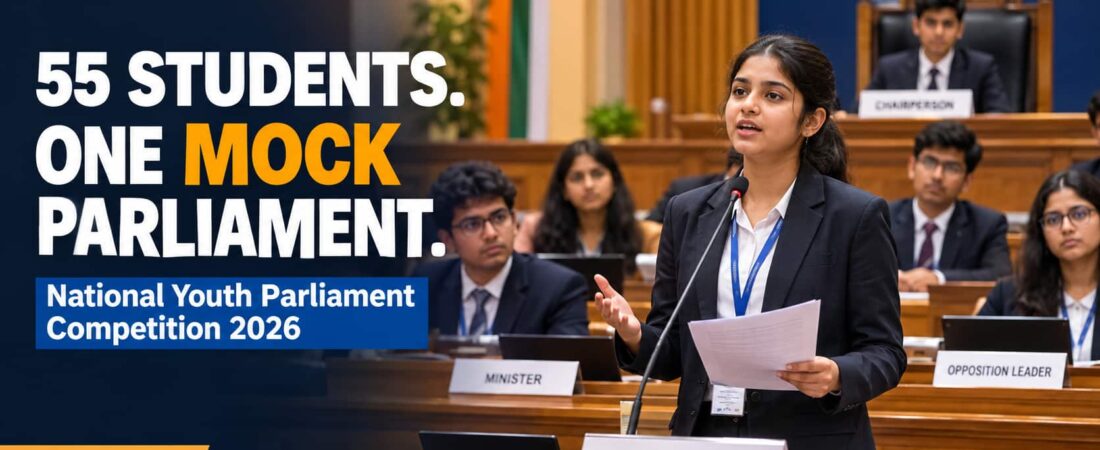
A Speaker in the chair. A Prime Minister leading the House. A Leader of the Opposition ready to respond. This was not New Delhi, but a university auditorium in Wardha. At the National Youth Parliament Competition 2026, 55 students took on parliamentary roles and debated education, healthcare, unemployment, inflation and farmers’ concerns.
The 18th Group-Level edition was organised by the Ministry of Parliamentary Affairs at Mahatma Gandhi Antarrashtriya Hindi Vishwavidyalaya (MGAHV), Wardha, on Saturday, 24 October 2026.
A Bill on compulsory voting was also introduced and discussed, according to the official PIB press release published on 25 October 2026.
📅 25 October 2026 | CareerView24 | Source: Official PIB
Key Highlights
Event: 18th Group-Level National Youth Parliament Competition, organised by the Ministry of Parliamentary Affairs, Government of India
Venue: Kasturba Auditorium, Mahatma Gandhi Antarrashtriya Hindi Vishwavidyalaya, Wardha
Participation: 55 students from various departments, including 21 women
Proceedings: A 55-minute session with Zero Hour, oath-taking, condolence motions and a Bill proposing compulsory voting
Top result: Divya Maharanwar, who played the Speaker of the Lok Sabha, secured first place
National Youth Parliament Competition 2026: Event Detail
The competition was held at Kasturba Auditorium on the MGAHV campus under the chairpersonship of Vice-Chancellor Prof. Kumud Sharma. According to the PIB release, it gave students an opportunity to understand parliamentary proceedings and to showcase their debating and oratory skills.
Prof. Prahlad Mane, Coordinator of Group VI of the National Youth Parliament Competition at Shivaji University, Kolhapur, attended as Chief Guest. Prof. Ravishankar More, Director of Dr. Ambedkar School of Law at Rashtrasant Tukadoji Maharaj Nagpur University, was the Guest of Honour.
Dr. Balaji Chirde, Associate Professor and Coordinator of the Youth Parliament, delivered the welcome address. Dr. Meera Nichale, Assistant Professor in the Department of Translation Studies, conducted the programme.
The ceremony followed a traditional pattern. Guests were welcomed with shawls, cotton garlands, mementoes and bouquets, and the programme began with the University anthem. It concluded with the National Song and the National Anthem. Deans, heads of departments, faculty members, research scholars and students attended.
How Students Participated in the Youth Parliament
Rather than simply watching a debate, the 55 participants took on the working roles of a parliamentary session. The release says students assumed positions such as the Speaker of the Lok Sabha, the Prime Minister, the Secretary-General of the Lok Sabha, the Leader of the Opposition and other ministers.
Two of these roles are tied to named participants. Divya Maharanwar played the Speaker of the Lok Sabha, and Shia, a student of the Department of Mass Communication, portrayed the Prime Minister. The release does not specify the roles of the other recognised students.
The participants came from various university departments, and the discussion covered a broad range of public concerns. The release names education, healthcare, unemployment, inflation and farmers’ concerns. It also notes that the session included deliberation on government schemes, and the guests specifically mentioned sports among the topics discussed.
Speaking to the participants, Prof. Kumud Sharma said that youth play a significant role in strengthening the foundations of democracy and are the backbone of the nation’s development. She commended the students’ candid views and logical reasoning. She also highlighted that 21 of the 55 contestants were women, noting that this reflected the spirit of Nari Shakti Vandan.
Key Issues Discussed During the Competition
The 55-minute session reproduced several features of a real legislative sitting. According to the PIB release, the proceedings included Zero Hour, oath-taking, condolence motions and discussions on matters of public importance. In the Indian Parliament, Zero Hour is the period when members raise urgent issues without prior notice, so including it gave students a view of how such matters surface in practice.
The most distinctive item was a Bill proposing compulsory voting, which was introduced and discussed during the proceedings. The release does not say whether it was put to a vote or what the outcome was. It is important to be clear that this was a classroom-style simulation: the discussion was a learning exercise, and nothing in the release suggests the proposal became law or carries any legal force.
Prof. Prahlad Mane and Prof. Ravishankar More appreciated the students’ performances. They observed that the discussions on education, healthcare, sports, unemployment, inflation and farmers’ issues demonstrated the participants’ awareness, talent and oratory skills.
National Youth Parliament Competition 2026 Winners
Six students were recognised for their performances. The placements reported in the PIB release are:
First place: Divya Maharanwar (played the Speaker of the Lok Sabha)
Second place: Priyanshu Kumar
Third place: Shia (Department of Mass Communication, portrayed the Prime Minister)
Fourth place (joint): Ankita Thul, Aman Maurya and Monika
The students were felicitated with mementoes, gold medals and certificates. The release gives no further details, such as cash prizes or onward rounds, so none should be assumed.
Why Youth Parliament Matters for Students
The following is general educational context rather than a claim made in the PIB release.
A youth parliament asks students to do more than memorise how a Bill becomes an Act. To speak as a minister or an opposition member, a participant must research an issue, build an argument, anticipate counter-points and respond within a formal set of rules. That combination strengthens public speaking, logical reasoning and the habit of listening before replying.
Such simulations also make civic institutions less abstract. Students who have practised a Zero Hour mention or a condolence motion tend to follow real parliamentary coverage with better understanding. For young citizens who will soon be first-time voters, that familiarity is a practical step towards informed participation.
The MGAHV event also fits a wider theme in the vice-chancellor’s remarks: that young people are central to democratic life. Debating a subject such as compulsory voting, whatever one’s own view, encourages students to weigh rights, duties and practical consequences.
What Students Should Know
This article reports on a completed competition held at MGAHV Wardha. The PIB release does not announce an application window, registration, eligibility rules or any recruitment opportunity.
It is not a job notification or an admission notice. Students interested in future editions should watch notices from their own university and the Ministry of Parliamentary Affairs.
Readers who prefer Marathi can read the Marathi version of the PIB release.
If you are following other updates for students, our Education Updates page collects the latest exam and education news in one place.
Students who are also preparing for competitive exams may find our guide on staying focused while studying for government exams useful. It is a separate topic and is not part of this event.
Frequently Asked Questions
1. What is the National Youth Parliament Competition 2026?
It is a mock-parliament competition for university students, organised by the Ministry of Parliamentary Affairs, Government of India. The 18th Group-Level edition was held at MGAHV Wardha, where students played parliamentary roles and debated public issues to show their debating and oratory skills.
2. Where was the Youth Parliament Competition 2026 held?
The competition was held at Kasturba Auditorium at Mahatma Gandhi Antarrashtriya Hindi Vishwavidyalaya (MGAHV) in Wardha, Maharashtra. It took place on Saturday, 24 October 2026, under the chairpersonship of Vice-Chancellor Prof. Kumud Sharma, according to the PIB release.
3. How many students participated in the competition?
A total of 55 students from various departments participated, according to the PIB release. Of these, 21 were women. Participants took on roles such as Speaker, Prime Minister, Leader of the Opposition and ministers during the 55-minute session.
4. Who won first place in the MGAHV Wardha Youth Parliament Competition?
Divya Maharanwar secured first place. She played the role of the Speaker of the Lok Sabha. Priyanshu Kumar placed second and Shia, who portrayed the Prime Minister, placed third. Ankita Thul, Aman Maurya and Monika jointly took fourth place.
5. Which ministry organised the competition?
The Ministry of Parliamentary Affairs, Government of India, organised the 18th Group-Level National Youth Parliament Competition 2026 at MGAHV Wardha. The details were reported in a release issued by PIB Mumbai on 25 October 2026.
Conclusion
The National Youth Parliament Competition 2026 at MGAHV Wardha brought 55 students, including 21 women, into a structured exercise in parliamentary debate.
They discussed education, healthcare, unemployment, inflation and farmers’ concerns, and worked through Zero Hour, oath-taking, condolence motions and a compulsory voting Bill.
Divya Maharanwar took first place, followed by Priyanshu Kumar and Shia, with three students sharing fourth. For students, the event shows that democratic participation can be practised and learned on campus.