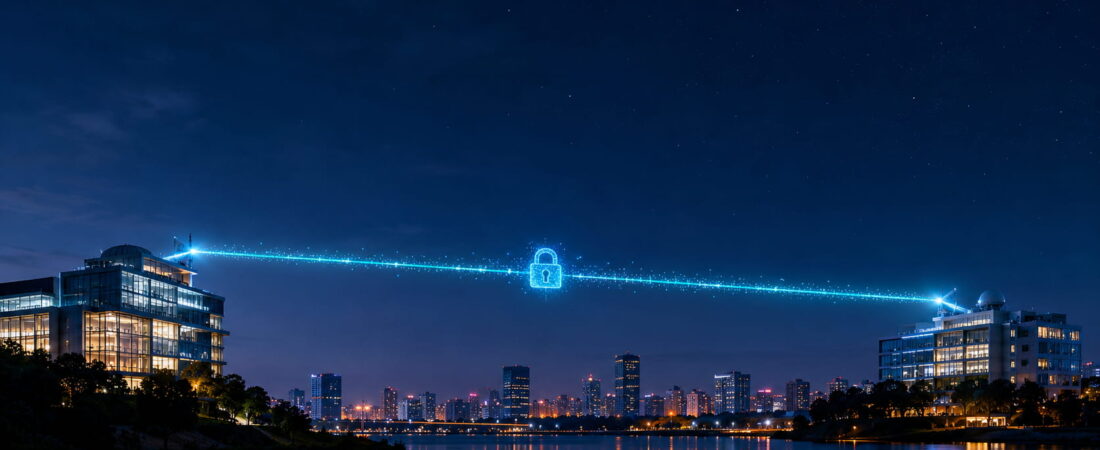
IIT Gandhinagar quantum communication just passed a milestone that could one day protect your UPI payments from tomorrow’s hackers. Every time you tap “Pay”, a tiny invisible lock clicks shut around your money. Scientists are now asking: what happens when someone builds a key that can open that lock?
On 3 October 2026, the Press Information Bureau announced India’s first free-space Quantum Key Distribution (QKD) link. Over 5.56 km of open air, a secret encryption key travelled between BISAG-N and IIT Gandhinagar, carried by single particles of light. The trial took place on the night of 27-28 September.
It will not change your phone tomorrow. But it is an early brick in the wall that may one day protect it.
Table of Contents
The problem nobody sees yet
Think of today’s encryption like a very complicated padlock. It is safe because picking it would take ordinary computers an absurd amount of time.
Quantum computers, once strong enough, could pick some of those locks much faster. And here is the sneaky part: an attacker doesn’t have to wait. They can copy encrypted data now, store it, and open it years later. Security people call this “harvest now, decrypt later.”
For a meme or a movie ticket, who cares. For defence plans, government records or financial systems that must stay secret for decades, it is a real worry.
A different kind of lock
QKD doesn’t try to build a harder padlock. It changes how the key is delivered.
Imagine sending your house key by courier, but the key is made of something so delicate that if anyone touches it, it visibly changes. If the key arrives unchanged, you know nobody tampered with it. If it arrives altered, you throw it away and send another.
That is the idea behind QKD, except the “key” is made of single photons, the smallest packets of light, and the “delicate material” is quantum physics. Interception disturbs the photons, so the sender and receiver can detect a spy. Note that QKD doesn’t carry your message itself. It only delivers the key that locks the message.
Why through the air, and not a cable?
QKD can also run through optical fibre cables. This trial is different because it is free-space: the photons travelled through open air.
Why does that matter?
- Speed of setup. A line-of-sight optical link doesn’t need trenches, permits or months of cable laying.
- Hard-to-reach places. Think borders, hills, temporary posts or places where fibre is impractical.
- The road to space. A satellite quantum link is a free-space link with one end in orbit. You cannot beam keys to a satellite until you have mastered doing it across open ground.
The air makes things difficult. Dust, turbulence and stray light all interfere with fragile photons. The two beams must also stay locked on each other over more than five kilometres, which is why the tracking system in this trial is such an important part of the story.
What Do a 5% QBER and 230-260 bps Actually Mean?
According to the official PIB press release, using QNu Labs’ Pointing, Acquisition and Tracking system, the trial achieved a stable Quantum Bit Error Rate below 5% and generated secure keys at 230-260 bits per second. Those numbers can look dry, so here is what they mean in everyday terms.
QBER below 5%: how clean was the line?
Imagine reading out a long number over a crackly phone call. QBER is the share of digits the listener got wrong. Under 5% means the connection stayed clear enough to build a trustworthy key, and “stable” means it didn’t wobble from minute to minute.
230-260 bits per second: is that slow?
It sounds tiny next to your home Wi-Fi, but you are comparing the wrong things. This link isn’t carrying videos or messages. It is making keys. A commonly used 256-bit key needs only 256 bits, so this link can produce roughly one fresh key’s worth of material each second. Like a bank OTP, a key doesn’t need to be big. It needs to be fresh and secret.
Pointing and tracking: why mention it?
Holding a laser steady on a target more than 5 km away, at night, with air constantly shimmering, is genuinely hard. Getting stable results means that part of the system worked.
The IIT Gandhinagar quantum communication trial worked because three very different organisations pulled in the same direction. The PIB press release credits this partnership
The clever backup plan
Here is a detail that is easy to miss. The keys from the quantum link were integrated with BISAG-N’s Vedic Kavach platform, which uses post-quantum cryptography and quantum random number generation, and the team successfully encrypted and decrypted test messages end to end.
Why does this matter? Because optical links can fail. Fog, heavy rain or a blocked path can interrupt the beam. The release explains that combining QNu Labs’ hardware device, Armos, with Vedic Kavach’s software layer keeps the system resilient even if the physical quantum channel is temporarily unavailable.
It is like having both a strong front-door lock and a second bolt inside. If one is briefly out of action, the other still holds.
IIT Gandhinagar Quantum Communication: The Three-Way Team Behind the Trial
The IIT Gandhinagar quantum communication trial worked because three very different organisations pulled in the same direction. The [PIB release]([PIB English release URL]) credits this partnership:
- QNu Labs, founded in 2016, supplied the QKD hardware and tracking system. Its co-founder and CEO Sunil Gupta says the result paves the way for longer-distance quantum-secure networks and satellite-based quantum communication.
- BISAG-N, an autonomous scientific society under MeitY, supplied Vedic Kavach. Director General Dr Vinay Thakur called the integration a significant step toward practical quantum-resilient communication.
- IIT Gandhinagar, founded in 2008, provided the far end and a real-world testing environment. Cmde Manish Tripathi (Retd.) said the work shows how academia, indigenous technology and real-world experimentation can come together.
IIT sector ki latest recruitment opportunity ke baare mein bhi padhein: IIT Delhi Indore Director Recruitment 2026 →
So, should you be excited or sceptical?
A bit of both, honestly.
Excited, because India has now field-tested a free-space quantum link with homegrown technology and paired it with post-quantum software. That builds sovereign capability in a field where depending on outsiders is risky.
Sceptical, because this is one link, over one distance, on one night. It doesn’t tell us how a nationwide network would behave. We still don’t know how the system copes with rain, haze or daylight. And “first” means India’s first, not the world’s, since other countries have run longer quantum links before.
The IIT Gandhinagar quantum communication result deserves both reactions. Good science news deserves applause and questions.
What would real progress look like?
If you want to track whether this becomes something bigger, watch for:
- Longer links and tests across different weather
- Operation in daylight, when sunlight adds noise
- Connections between free-space and fibre networks
- Eventually, satellite-based quantum communication
5.56 km Quantum Communication Trial ki detail India Today par padhein. India Today Report
Final Thoughts
IT Gandhinagar quantum communication may sound like a distant, academic phrase today, but it points to something very close to home. Your UPI payments, your bank messages and your private chats all sit behind locks you never see. This 5.56 km experiment is a small sign that India is getting ready for the day those locks need an upgrade.
It was one link, on one night, and it is only an early step. But every secure network starts exactly like this. In a few years, the beam of light that crossed the night air in Gujarat could be part of how the country keeps its most important secrets safe.
Explore more engineering education updates and discover the Top Engineering Colleges in India 2026 → for rankings, courses and admission details.
FAQs
What is IIT Gandhinagar Quantum Communication?
It is a 5.56 km free-space QKD demonstration involving IIT Gandhinagar, BISAG-N and QNu Labs.
Did IIT Gandhinagar do this alone?
No. QNu Labs, BISAG-N and IIT Gandhinagar worked together on the demonstration.
What did the trial achieve?
It achieved a QBER below 5%, generated keys at 230–260 bps, and successfully encrypted and decrypted test messages.
Does this make UPI or WhatsApp safer today?
Not directly. The IIT Gandhinagar Quantum Communication trial is an important step toward future quantum-secure communication networks.
Is QKD completely unhackable?
No. QKD strengthens key security, but the overall system still depends on secure hardware, software and proper implementation.