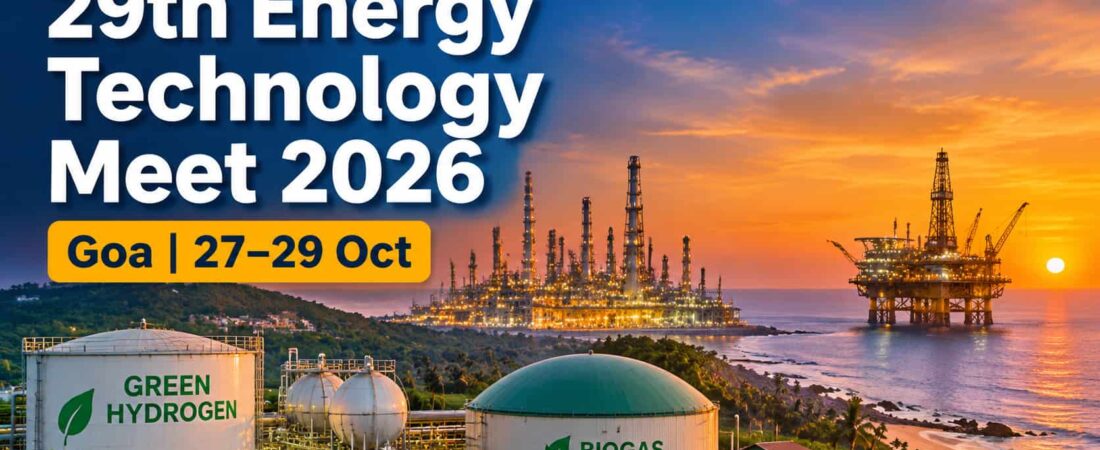
The 29th Energy Technology Meet 2026 began on 27 October 2026 at the ONGC Advanced Training Institute in Goa. Union Petroleum and Natural Gas Minister Hardeep Singh Puri inaugurated it. According to the Press Information Bureau (PIB), the three-day event brings together policymakers, industry leaders, researchers and technology experts to discuss innovations shaping India’s energy future.
Day 1 discussions covered energy security, affordability, the energy transition and LPG supply diversification. Two government schemes drew particular attention: GOBARdhan, with an outlay of ₹23,731 crore, and Samudra Manthan, with an approved outlay of ₹84,084 crore. Both bear on how India can widen its energy mix while strengthening domestic production.

Key Takeaways
- The 29th Energy Technology Meet (ETM) began on 27 October 2026 at the ONGC Advanced Training Institute, Goa. It continues until 29 October 2026.
- Union Minister Hardeep Singh Puri inaugurated the event.
- It is organised by the Centre for High Technology (CHT) under the Ministry of Petroleum and Natural Gas, with HPCL as co-host. The theme is “Accelerating Energy Innovation: From Research to Commercialisation.”
- GOBARdhan (National Circular Bioenergy Scheme) has an outlay of ₹23,731 crore for FY 2026–27 to FY 2035–36.
- Samudra Manthan (National Offshore Exploration Scheme) has an approved outlay of ₹84,084 crore up to FY 2030–31.
- Key technology areas include green hydrogen, sustainable aviation fuel, carbon capture, crude-to-chemicals, biofuels and gas-based energy.
What Is the 29th Energy Technology Meet 2026?
The Energy Technology Meet (ETM) is a platform where India’s energy sector discusses technology, research and commercial adoption. The 29th edition is organised by the Centre for High Technology (CHT) under the aegis of the Ministry of Petroleum and Natural Gas. It is co-hosted by Hindustan Petroleum Corporation Limited (HPCL).
The theme is “Accelerating Energy Innovation: From Research to Commercialisation.” PIB says the platform aims to strengthen collaboration across the energy value chain and speed up the commercial adoption of emerging technologies.
Participants include representatives from renewable energy, mobility, oil and gas, petrochemicals, research institutions, consulting firms, catalyst manufacturers and engineering, procurement and construction (EPC) companies. Process licensors, who supply proven process technologies to refiners and chemical plants, are also part of the event.
Key Highlights of Energy Technology Meet 2026
Day 1 featured a fireside chat between Mr Puri and journalist Palki Sharma Upadhyay. PIB lists the topics as energy security, affordability, the energy transition and LPG supply diversification. The release does not report specific statements from the session.
The Minister also toured the exhibition. Technology providers, process licensors, engineering firms and energy companies showcased solutions for the downstream hydrocarbon sector, which broadly covers refining and the supply of fuels to consumers.
LPG diversification was discussed in the context of supply resilience, fuel availability and affordability for consumers. Mr Puri also held a press conference on fuel availability, energy security, the energy transition and efforts to diversify energy sources.
Other Day 1 items included MC² Ignite, which highlighted innovation in the sector, and a MoPNG session on building a start-up ecosystem in India. The programme also features the Start-Up Awards and Refinery Performance & Innovation Awards.
GOBARdhan Scheme: ₹23,731 Crore Outlay
PIB describes GOBARdhan as the National Circular Bioenergy Scheme. It has an outlay of ₹23,731 crore for FY 2026–27 to FY 2035–36. The money is meant to scale up compressed biogas (CBG) production and support the growth of the circular bioeconomy.
In simple terms, CBG is biogas purified so it can be used as a fuel. A circular bioeconomy broadly means turning organic waste and biomass into useful products rather than discarding them.
The release does not mention eligibility rules, production targets or beneficiary benefits. An outlay is planned funding, not proof of results already achieved.
Samudra Manthan Scheme: ₹84,084 Crore for Offshore Exploration
Samudra Manthan, the National Offshore Exploration Scheme, has an approved outlay of ₹84,084 crore up to FY 2030–31. PIB says it aims to boost oil and gas exploration in deepwater and ultra-deepwater areas, strengthen domestic resource development and contribute to India’s long-term energy security.
Deepwater and ultra-deepwater refer to offshore areas with greater sea depths, where exploration is technically demanding and costly. The release does not specify depth thresholds, blocks or project timelines.
Technologies in Focus at ETM 2026
PIB names these key focus areas for the meet:
- Green hydrogen: hydrogen produced using renewable energy.
- Sustainable aviation fuel (SAF): a lower-emission alternative to conventional jet fuel.
- Carbon capture: trapping carbon dioxide emissions before they reach the atmosphere.
- Crude-to-chemicals: converting crude oil into petrochemicals rather than only fuels.
- Biofuels and gas-based energy: alternative and transition fuels.
The R&D Conclave by the Federation of Indian Petroleum Industry (FIPI) adds Net Zero refineries, energy efficiency, green hydrogen, biomass valorisation, water management and emerging technologies. Biomass valorisation means converting biomass into higher-value products.
Why Does the Event Matter for India’s Energy Security?
This section is editorial analysis, not part of the PIB release.
The theme “From Research to Commercialisation” points to a familiar gap: promising technology that struggles to reach the market. Bringing researchers, licensors, refiners and engineering firms together at the 29th Energy Technology Meet 2026 can make partnerships easier. The release does not say whether any agreements will follow.
The two schemes work on different fronts. Samudra Manthan targets domestic hydrocarbons offshore. GOBARdhan targets home-grown gas from organic waste. They also run on different timelines, with Samudra Manthan up to FY 2030–31 and GOBARdhan to FY 2035–36.
LPG diversification matters because supply resilience affects households directly, and PIB links it to availability and affordability. Still, discussing these priorities does not guarantee lower fuel prices, energy independence or immediate jobs. Outcomes will depend on execution, exploration results and market conditions.
What Happens Next?
The meet continues until 29 October 2026 with technical presentations, panel discussions, poster sessions and the exhibition. Experts from India and abroad will share research and look for ways to turn technological advances into commercially viable solutions. The FIPI R&D Conclave, start-up activities and awards are also on the programme.
PIB has not announced any new policy decisions linked to the meet. For readers tracking India’s energy transition, the 29th Energy Technology Meet 2026 is a useful marker of where industry and government attention is heading. Further official updates will appear on the PIB and Ministry of Petroleum and Natural Gas websites.
Frequently Asked Questions (FAQs)
1. What is the 29th Energy Technology Meet 2026?
It is the 29th edition of the Energy Technology Meet, a three-day event on emerging energy technologies. It is organised by the Centre for High Technology under the Ministry of Petroleum and Natural Gas and co-hosted by HPCL. The theme is “Accelerating Energy Innovation: From Research to Commercialisation.”
2. Where was ETM 2026 inaugurated?
ETM 2026 was inaugurated on 27 October 2026 at the ONGC Advanced Training Institute in Goa. The meet continues until 29 October 2026.
3. Who inaugurated the 29th Energy Technology Meet?
Union Minister of Petroleum and Natural Gas Hardeep Singh Puri inaugurated the 29th Energy Technology Meet 2026. He also joined a fireside chat, visited the exhibition stalls and addressed a press conference on Day 1.
4. What are the GOBARdhan and Samudra Manthan financial figures mentioned in the PIB release?
GOBARdhan, the National Circular Bioenergy Scheme, has an outlay of ₹23,731 crore for FY 2026–27 to FY 2035–36. Samudra Manthan, the National Offshore Exploration Scheme, has an approved outlay of ₹84,084 crore up to FY 2030–31.
5. Which energy technologies are being discussed at ETM 2026?
Key areas include green hydrogen, sustainable aviation fuel, carbon capture, crude-to-chemicals, biofuels and gas-based energy. The FIPI R&D Conclave also covers Net Zero refineries, energy efficiency, biomass valorisation and water management.