
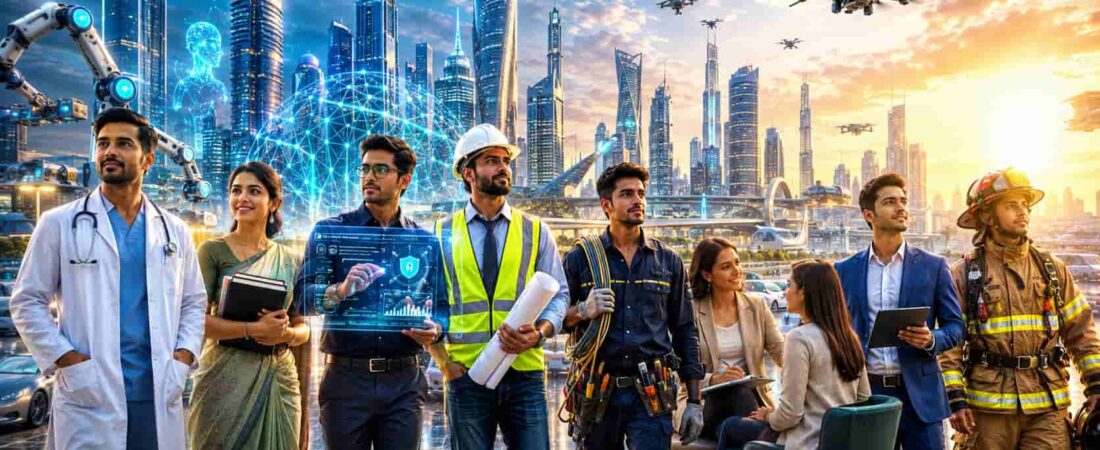
Artificial intelligence is transforming workplaces faster than ever. From writing emails and generating images to automating customer support and analyzing data, AI is reshaping almost every industry. As a result, millions of students and professionals are wondering whether their careers will still be relevant in the future. The good news is that AI Won’t Replace These Jobs because they depend on uniquely human qualities like creativity, empathy, leadership, critical thinking, and hands-on expertise. In this guide, you’ll discover 10 future-proof careers that are expected to thrive in 2026 and beyond, along with the skills you should build today to stay ahead in the AI era.
Want to boost your career with future-ready skills? Read our guide on High Salary Skills to Learn in 2026 and discover the most in-demand skills employers are looking for.
Table of Contents
Why AI Won’t Replace These Jobs: What Makes Them Future-Proof
Artificial intelligence can automate repetitive tasks, analyze large amounts of data, and improve efficiency. However, it still cannot match human qualities like creativity, empathy, leadership, critical thinking, and ethical decision-making. These skills are essential in many professions where trust and personal interaction matter most.
That’s why AI Won’t Replace These Jobs. Careers that depend on human judgment, emotional intelligence, hands-on expertise, and solving real-world challenges are expected to remain valuable. Instead of replacing these professionals, AI will serve as a powerful tool that helps them work smarter and more efficiently.
Want to understand how artificial intelligence is reshaping employment and workplace trends worldwide? Explore the OECD AI and Work Report for trusted insights, research, and expert analysis on the future of jobs.
1. Healthcare Professionals
Doctors, nurses, surgeons, physiotherapists, and mental health professionals will continue to play an essential role in society. AI can assist by analyzing medical reports or detecting diseases earlier, but patients still depend on healthcare professionals for diagnosis, treatment decisions, emotional support, and emergency care.
Medical care is built on trust and compassion—qualities that machines cannot truly provide.
2. Teachers and Educators
Education is far more than delivering information. Great teachers inspire students, understand their strengths and weaknesses, and adapt lessons based on individual learning styles. AI can support learning with personalized exercises and instant answers, but it cannot replace mentorship, motivation, or the human connection between teachers and students.
As digital learning expands, educators who use AI as a teaching assistant will become even more valuable.
Students can also build valuable experience by exploring the Best Part-Time Jobs for College Students Online while preparing for a future-proof career.
3. Mental Health Professionals
Mental health awareness continues to grow worldwide, increasing the need for psychologists, therapists, and counselors. AI chatbots may offer basic guidance, but they cannot genuinely understand human emotions, trauma, or personal experiences.
People seeking help often need empathy, trust, and meaningful conversations—something only trained professionals can provide.
4. Entrepreneurs and Business Leaders
Starting and growing a successful business requires creativity, leadership, and strategic decision-making. While AI can help with market research, content creation, and automation, it cannot replace the vision and risk-taking mindset of entrepreneurs.
Business owners who combine human innovation with AI tools are likely to have a competitive advantage in the future.
5. Creative Professionals
Many people worry that AI-generated content will replace writers, designers, filmmakers, and marketers. Although AI can create text, images, and videos, it still relies on existing patterns rather than genuine imagination.
Creative professionals who focus on storytelling, branding, emotional marketing, and original ideas will continue to stand out. In fact, AI is becoming a powerful assistant rather than a replacement for creative work.
Looking Ahead
The future of work is not about humans competing against AI—it’s about learning how to work with it. Careers built on creativity, empathy, leadership, communication, and specialized expertise are expected to remain valuable even as technology advances
As artificial intelligence becomes part of everyday work, one thing is becoming clear: the future belongs to people who know how to work with AI, not against it. While automation will change many industries, several careers will continue to depend on human expertise, judgment, and adaptability. Here are more professions that are expected to remain valuable in the years ahead.
6. Cybersecurity Professionals
As businesses, governments, and individuals rely more on digital systems, cyber threats continue to grow. AI can detect suspicious activity and automate some security tasks, but cybercriminals constantly develop new attack methods that require human investigation and strategic thinking.
Cybersecurity experts protect sensitive information, respond to security incidents, and design systems that keep organizations safe. This field is expected to see strong demand for many years.
7. Engineers and Problem Solvers
Whether it’s civil engineering, mechanical engineering, aerospace, or renewable energy, engineers solve complex real-world challenges. AI can assist with calculations and simulations, but designing safe infrastructure, managing projects, and making engineering decisions still require human expertise.
As technology advances, engineers who understand both traditional engineering and AI tools will have even greater opportunities.
8. Scientists and Researchers
Scientific discoveries depend on curiosity, experimentation, and asking questions that have never been answered before. AI can analyze research data much faster than humans, but it cannot independently decide which problems are worth solving or develop entirely new scientific theories.
Researchers in medicine, environmental science, biotechnology, and physics will continue to play a vital role in shaping the future.
9. Emergency Responders
Firefighters, police officers, disaster response teams, and paramedics work in unpredictable environments where every second matters. These professionals must make life-saving decisions under pressure while communicating with victims and coordinating rescue operations.
Although AI can provide useful information during emergencies, human courage, judgment, and teamwork remain irreplaceable.
10. Managers and Leaders
Every successful organization needs leaders who can motivate teams, resolve conflicts, make strategic decisions, and build a positive workplace culture.
AI may provide reports and recommendations, but leadership is about understanding people, managing change, and making difficult decisions that affect employees and customers. These responsibilities require emotional intelligence that machines cannot replicate.
Skills That Will Keep You Valuable in the AI Era
Instead of worrying about AI replacing jobs, focus on building skills that complement technology.
Some of the most valuable future-ready skills include:
- Critical thinking and problem-solving
- Communication and public speaking
- Creativity and innovation
- Emotional intelligence
- Leadership and teamwork
- Digital literacy and AI awareness
- Adaptability and continuous learning
Professionals who regularly update their skills will have a significant advantage regardless of how technology evolves.
Should You Be Afraid of AI?
The answer is no—but you should be prepared.
History shows that every major technological breakthrough has changed the job market. Some roles disappear, but new careers also emerge. AI is expected to create opportunities in areas such as AI management, cybersecurity, robotics, healthcare technology, and digital transformation.
The biggest risk is not AI itself—it is refusing to learn new skills.
People who embrace lifelong learning, stay curious, and adapt to new technologies are more likely to build successful careers in the future.
Final Thoughts
Artificial intelligence is transforming the way we work, but it is unlikely to replace every profession. Careers that depend on creativity, empathy, leadership, human relationships, and specialized expertise are expected to remain valuable for decades.
Rather than asking, “Will AI take my job?”, ask yourself a better question:
“What skill can I develop that AI cannot easily replace?”
The answer to that question will help you build a stronger and more secure career in the AI era.
Looking for flexible career opportunities? Explore our list of Best Work From Home Jobs for Freshers in India to find beginner-friendly remote careers.
Frequently Asked Questions (FAQs)
1. Which jobs are least likely to be replaced by AI?
Healthcare professionals, teachers, cybersecurity experts, engineers, skilled trades, therapists, emergency responders, and leadership roles are among the careers considered the most resistant to automation because they require human judgment and interpersonal skills.
2. Will AI replace software developers?
AI can assist developers by generating code and finding bugs, but software engineers are still needed to design systems, solve complex problems, review AI-generated code, and build innovative products.
3. What skills should students learn to stay relevant?
Students should focus on communication, critical thinking, creativity, emotional intelligence, digital skills, and continuous learning. Understanding how to use AI tools effectively will also become an important advantage.
4. Is AI creating new career opportunities?
Yes. AI is generating demand for roles in AI engineering, machine learning, cybersecurity, data science, AI ethics, robotics, automation, and digital transformation across many industries.
5. Should I avoid careers that use AI?
No. The smartest approach is to choose a career you enjoy and learn how AI can improve your productivity. Professionals who use AI effectively are likely to have better career opportunities than those who avoid it altogether.