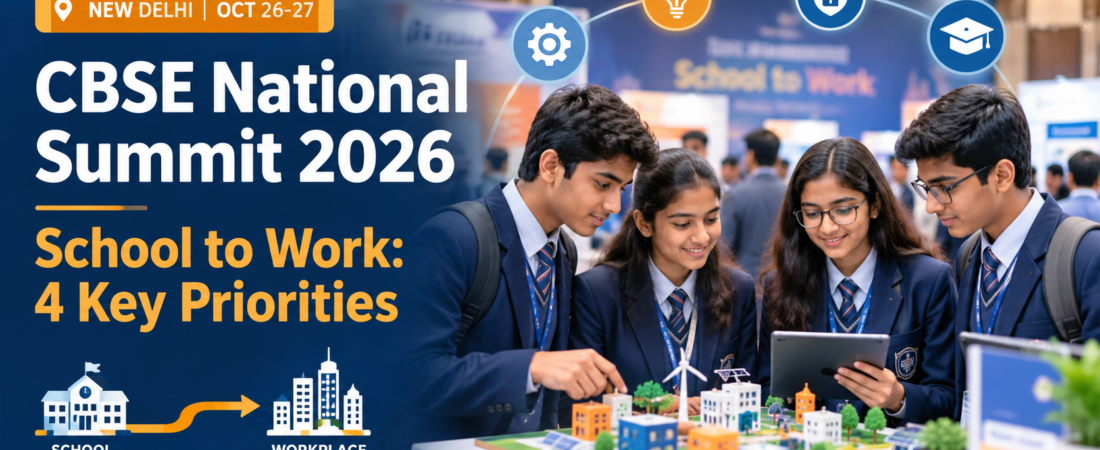
How do you prepare students for a job market that keeps changing? That is the question at the centre of the CBSE National Summit 2026, the 4th National Summit on “Facilitating School-to-Work Transition.”
The two-day event is being held on October 26-27 in New Delhi. It is organised by CBSE with the Sahodaya School Complexes of Delhi/NCR to bring skill education into mainstream schooling.
Education Secretary T. K. Anil Kumar and CBSE Chairman Dr. Mandeep Bhandari were present, DD News reported, citing PIB inputs.

Key Takeaways
- Organisers: CBSE, with the Sahodaya School Complexes of Delhi/NCR.
- Dates and venue: October 26–27, 2026, in New Delhi.
- Four priorities: technology and digital safety; design and creativity; skill recognition through the National Credit Framework; career guidance with equitable pathways.
- Participants: school leaders, educators, industry experts and policymakers.
- Format: expert discussions, interactive sessions, and case-based papers and posters from CBSE-affiliated schools.
What Is the CBSE National Summit 2026?
The CBSE National Summit 2026 is a national platform on skill education and school-to-work transition, organised by CBSE. It is the fourth edition of a series that CBSE has held in different cities. Its central question is practical: how can schools equip students with competencies for a changing employment landscape while keeping them connected to mainstream education?
The summit’s focus is on shared learning. Educators, industry representatives and policymakers exchange ideas on teaching methods, assessment and skill education models. It is a deliberation forum, not a scheme launch, and the source reports no new policy decisions.
Dates, Venue and Organisers
As reported by DD News, the summit is being held on October 26–27 in New Delhi. CBSE is organising it with the Sahodaya School Complexes of Delhi/NCR, which are clusters of schools that work together on academic and co-curricular activities.
The dates changed after the initial announcement. A CBSE notification states that the summit, originally scheduled for September 23–24, 2026, was rescheduled to October 26–27. You can read the official CBSE rescheduling notification for the schedule change. The Ministry of Education press release, as carried by DD News, was the primary source for the details of the event itself. cbseacademic
Four Priorities Outlined by T. K. Anil Kumar
Speaking at the summit, Secretary of the Department of School Education and Literacy (DoSEL) T. K. Anil Kumar outlined four key priorities. They are priorities for discussion and direction, not newly implemented rules.
1. Technology, digital safety and skills. As classrooms and workplaces become more digital, students need both technical ability and safe, responsible online habits. Readers following this shift may also like our guide to Google AI study tools for JEE and NEET, which shows how technology is entering student preparation.
2. Design, creativity and innovation. This priority points to learning that goes beyond textbooks. Creative and design-oriented thinking is increasingly relevant to future-ready skills, and the summit includes a display of student innovations.
3. Recognition of skills through the National Credit Framework. The aim is to recognise skills across education systems, so that learning gained in different settings can be counted and valued.
4. Career guidance with equitable pathways. Students from different backgrounds should be able to access guidance and make informed choices about their futures.
Why Skill Recognition and Career Guidance Matter
Students often face a gap between what they study in school and what higher education or employers expect. Mr. Kumar called for a seamless transition from school education to higher education, skilling and employment. He said it should help learners make informed choices, pursue lifelong growth, contribute to society and live with dignity.
The National Credit Framework is relevant here because it addresses a long-standing problem: skills learned outside conventional academic routes are not always formally recognised. Recognition across systems could, in principle, let students move between academic and skill-based pathways without losing the value of their learning.
Career guidance with equitable pathways matters just as much. Students in smaller towns or under-resourced schools may lack access to counselling and exposure to career options. Making guidance more inclusive is a stated priority, though the source does not describe a specific mechanism.
Higher education is part of the same pathway. Students and parents exploring options after school can look at how learning platforms work, such as SWAYAM July semester registration, or compare institutions through our list of the top engineering colleges in India in 2026.
The NEP 2020 Connection
The summit is linked to the vision of the National Education Policy (NEP) 2020. According to the source, the summit underscores the importance of breaking down barriers among different streams of education and preparing students with the competencies needed for an evolving employment landscape.
NEP 2020 envisions a more flexible education system in which academic, vocational and skill-based learning are not rigidly separated. The CBSE National Summit 2026 is one forum where school leaders and policymakers discuss how that vision can be put into practice in classrooms. It is not a new implementation order. It is a space to discuss how the policy’s principles can work on the ground.
Who Is Participating and What Is Being Discussed
The summit brings together school leaders, educators, industry experts and policymakers. The press release says they are deliberating on emerging workforce requirements and innovative approaches to prepare students for future careers.
Through interactive sessions and expert discussions, participants are exploring:
- innovative pedagogical practices
- emerging assessment approaches
- digital integration in education
- effective models for strengthening skill education
Educators from CBSE-affiliated schools are also presenting case-based papers and posters on success stories and best practices in skill education. These show how ideas are working in real schools, which is often more useful to teachers than theory alone.
The summit also offers networking opportunities, so participants can build partnerships and support each other. A school that has built a strong skill education programme, for example, could share its experience with another that is starting out.
What the CBSE National Summit 2026 Means for Students, Teachers, Parents and Schools
The summit does not announce jobs, scholarships, recruitment drives or new government schemes. Its value is directional, and readers should treat it that way.
For students: Skill education is being positioned as part of mainstream schooling, not an add-on. Students can explore their interests early, including technology, design and creative fields, and seek career guidance in school.
For teachers: The case-based papers, posters and sessions on pedagogy and assessment give educators practical ideas to adapt in their own classrooms.
For parents: The emphasis on informed choices and equitable pathways suggests that career decisions need not be limited to a few conventional streams. Parents can ask their child’s school how skill education and counselling are offered.
For schools: Networking and shared best practices can help schools learn from peers and build partnerships.
Whether these priorities lead to concrete changes will depend on follow-up by CBSE, the Ministry of Education and schools. For now, the CBSE National Summit 2026 shows where school education policy is headed: towards stronger links between classrooms, skills and careers.
The full report is available on DD News.
FAQs
1. What is the CBSE National Summit 2026?
It is the 4th National Summit on “Facilitating School-to-Work Transition,” organised by CBSE with the Sahodaya School Complexes of Delhi/NCR to strengthen skill education within mainstream schooling.
2. When and where is the summit being organised?
It is being held on October 26–27, 2026, in New Delhi. It was originally scheduled for September 23–24 and later rescheduled.
3. What are the main priorities of the summit?
T. K. Anil Kumar outlined four: technology, digital safety and skills; design, creativity and innovation; skill recognition through the National Credit Framework; and career guidance with equitable pathways.
4. How does the summit relate to skill education and career guidance?
It discusses ways to integrate skill education into school learning and make career guidance accessible, so students can make informed choices about higher education, skilling and employment.
5. What is the connection between the summit and NEP 2020?
The summit reflects NEP 2020’s vision of breaking down barriers between education streams and equipping students with the competencies needed for a changing workforce.