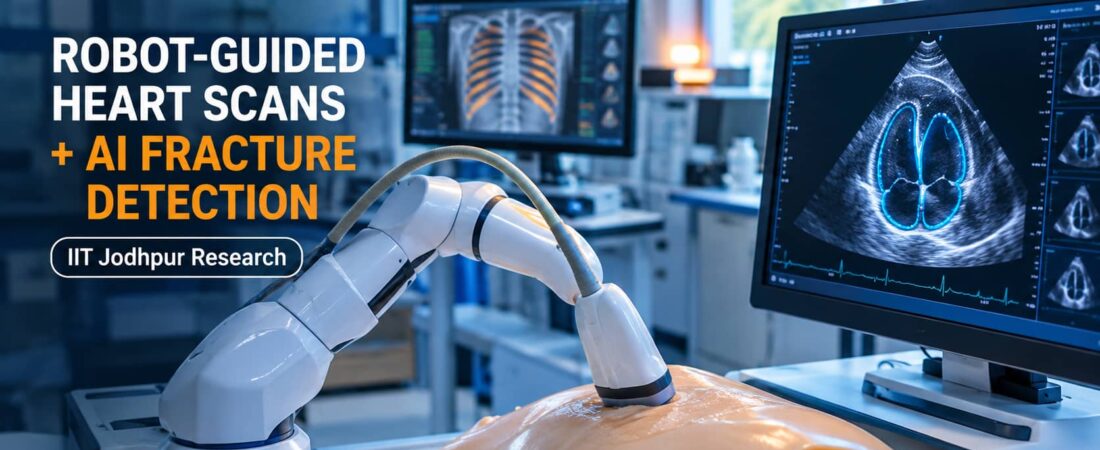

IIT Jodhpur is developing an AI-guided robotic system to hold the ultrasound probe during heart scans, along with an Agentic AI tool to locate rib fractures on medical scans. The work comes from the Medical AI Systems Lab (MAISys Lab), led by Dr. Deepak Mishra, and was announced in a Ministry of Education release issued through PIB Jaipur on 14 October 2026, at 5:13 PM.
This IIT Jodhpur AI Healthcare Research targets practical bottlenecks: operator-dependent heart ultrasound, time-consuming rib fracture analysis and limited access to realistic training. The release does not present any system as a finished hospital product.
What Is IIT Jodhpur AI Healthcare Research?
The Indian Institute of Technology Jodhpur (IIT Jodhpur) is exploring how artificial intelligence in healthcare and robotics can make medical imaging more consistent, support faster analysis of complex scans and create more interactive clinical learning. The effort sits in the Medical AI Systems Lab, headed by Dr. Deepak Mishra, Associate Professor in the Department of Computer Science and Engineering. His IIT Jodhpur faculty profile lists medical image analysis among his research interests.
According to the release, the lab works across three areas:
- AI-guided robotic ultrasound imaging, particularly echocardiography
- Computational analysis of medical images, including rib fracture analysis
- Simulation-based medical education
The shared aim is to bring together AI, robotics and medical expertise to support clinical workflows and strengthen medical education. The release names three pressures behind the work: the demands on specialist professionals, the time needed to analyse complex diagnostic images, and the need for accessible, realistic learning environments.
AI-Guided Robotic Heart Scans
Ultrasound is popular because it is relatively affordable, safe and portable. But the picture you get depends heavily on how the probe is held and moved. In echocardiography, the ultrasound scan of the heart, capturing usable images takes skill and experience, so trained professionals carry a heavy load.
The MAISys Lab is developing an AI-guided robotic system for this task. A robotic mechanism holds the probe, while an AI module is designed to guide its movement and positioning. The goal is to reduce reliance on manual probe handling and support more consistent image acquisition.
The research team calls this robotic heart ultrasound work a first-of-its-kind effort in India; that is the team’s description, not an independent assessment.
If developed and validated, the technology could help professionals perform cardiac ultrasound more efficiently and may contribute to future efforts to extend access to imaging expertise. The release adds that its clinical usefulness and suitability for different healthcare settings will need appropriate validation. It does not mention any trial, timeline or hospital deployment.
Watch: IIT Jodhpur’s Research on Robotics and Medical Imaging
AI-Powered Rib Fracture Detection
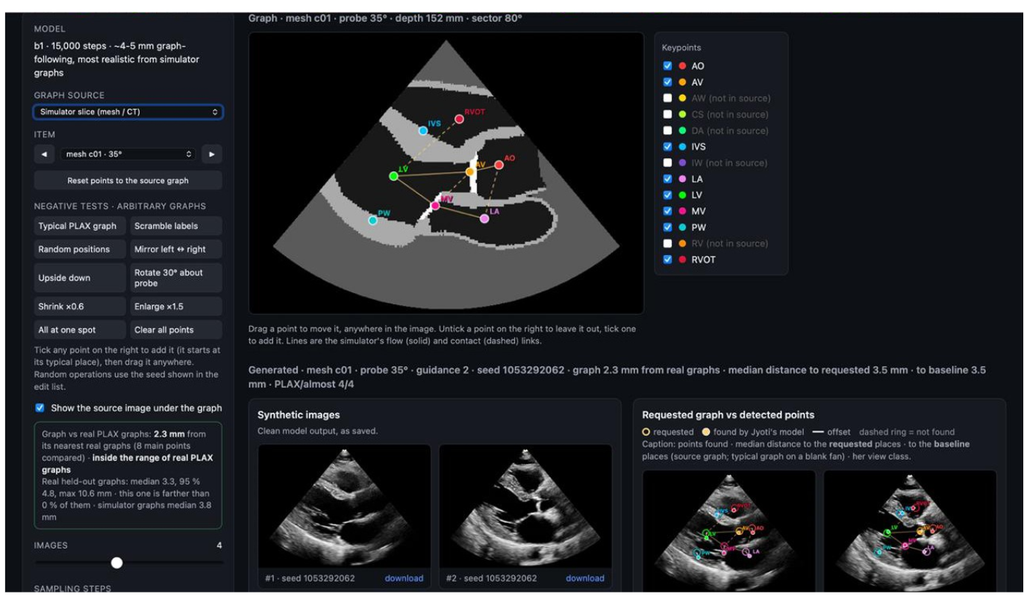
Medical images hold valuable information, but reading large volumes of scans takes time and specialist attention. Medical image computing uses computational techniques to extract and organise clinically relevant information from images. At IIT Jodhpur, the team is developing such methods for CT scans, MRI scans and ultrasound images.
One focus is rib fracture analysis. Examining several ribs individually can be slow for radiologists, particularly when a patient has multiple injuries. The team is therefore developing an Agentic AI-based solution designed to automatically identify the locations of different types of rib fractures and characterise them according to clinical standards.
The release does not define Agentic AI or explain how the system is built. In general usage, the term describes AI that works through multiple steps towards a goal; how MAISys Lab applies it here is not specified.
The system aims to bring relevant findings together into one comprehensive view, so clinicians can review information without relying entirely on repetitive manual examination. The release is explicit that the tool is being developed to support medical professionals, not to replace expert clinical judgement. It reports no accuracy figures or test results.
Simulation-Based Medical Education
The third area is medical education. Students and healthcare professionals need chances to observe, understand and practise complex clinical procedures, yet realistic environments and repeated demonstrations can be limited in some learning settings.
The MAISys Lab is building interactive tools that include clinical scanning simulators and videos of ophthalmic (eye) surgeries. These are designed so that different aspects of a procedure can be changed through simple user interactions or prompts. Learners can then explore variations, see how changes affect the outcome and build a clearer picture of complex clinical processes in a simulated setting.
Why IIT Jodhpur AI Healthcare Research Matters
The three projects address different stages of healthcare: acquiring images, interpreting them and training the people who will use them.
The potential benefits, none of them proven yet, include:
- More consistent ultrasound image acquisition
- Less repetitive manual work in scan analysis
- More interactive and accessible clinical learning
Dr. Deepak Mishra framed the lab’s thinking this way: “Artificial Intelligence can make a meaningful difference in healthcare when it is designed around the real needs of doctors, patients and medical learners.”
IIT Jodhpur is not the only institute in the news for frontier technology. We recently explained how IIT Gandhinagar and partners demonstrated India’s first 5.56 km free-space quantum key distribution link, another PIB-announced IIT project.
Current Development Status and Limitations
The current stage of IIT Jodhpur AI Healthcare Research is development, not deployment. The release says further development, testing and clinical validation will be important in deciding how these technologies can become practical healthcare applications.
The source does not report:
- Clinical trial results or accuracy percentages
- Hospital partnerships or deployment
- Funding amounts, patents or launch dates
- Evidence of improved patient outcomes
These tools should therefore be read as research directions, not approved medical products. They are also positioned as aids for clinicians; expert judgement remains central.
Key Facts at a Glance
- Announced: 14 October 2026, 5:13 PM, by PIB Jaipur (Ministry of Education)
- Lab: Medical AI Systems Lab (MAISys Lab), IIT Jodhpur
- Lab lead: Dr. Deepak Mishra, Associate Professor, Computer Science and Engineering
- Area 1: AI-guided robotic ultrasound, particularly echocardiography
- Area 2: Computational image analysis, including an Agentic AI tool for rib fractures
- Area 3: Clinical scanning simulators and ophthalmic surgery videos
- Status: Under development; validation required
Frequently Asked Questions
What is IIT Jodhpur AI Healthcare Research?
It is the work of the Medical AI Systems Lab at IIT Jodhpur, led by Dr. Deepak Mishra. It covers AI-guided robotic ultrasound, AI-based medical-image analysis including rib fractures, and simulation-based medical education.
How could AI-guided robotic ultrasound help with heart scans?
A robotic mechanism holds the probe while an AI module guides its movement and positioning. The intention is to reduce dependence on manual probe handling and make echocardiography images more consistent. This benefit is intended, not yet proven, and needs validation.
How is Agentic AI being developed for rib fracture detection?
The team is building a solution to automatically identify the locations of different rib fracture types and characterise them according to clinical standards, then present findings in one comprehensive view. The release gives no details on its architecture, training data or performance.
Will these AI technologies replace doctors or radiologists?
No. The release describes the work as support for medical professionals, not a replacement for expert clinical judgement.
Are IIT Jodhpur’s medical AI technologies already available in hospitals?
The release does not report any hospital deployment or commercial availability. IIT Jodhpur AI Healthcare Research is at the development stage, and further testing and clinical validation are needed before practical use.
Conclusion
IIT Jodhpur AI Healthcare Research brings robotics, imaging and education into one programme of work: a robot-assisted route to heart scans, AI support for rib fracture analysis and simulators for learners. Its promise lies in supporting clinicians and students, but the evidence is still to come. Further validation will decide how far it travels beyond the lab.
Source: Press Information Bureau, Ministry of Education, release dated 14 October 2026 (Release ID: 2323365)