 Written by Sajal Rathaur | CareerView24 | Published: 18 October 2026 | Author & Editorial Information
Where does a street business go when the day ends? For many vendors, the answer is a crowded roadside corner, a borrowed shed or a heavy cart left out overnight. IIT Kharagpur is now testing a different answer: a small business that travels to customers in the morning and comes home with its owner at night.
The IIT Kharagpur Solar Smart Cart was announced by the Ministry of Education through PIB Kolkata on 17 October 2026. It is part of a pilot called Nagar Udyam, and it is still a campus trial, not a product you can buy today. Even so, the idea touches livelihoods, food safety and the way Indian cities share road space.
What Is the IIT Kharagpur Solar Smart Cart?
As per the PIB Kolkata press release, Nagar Udyam — From Street Vendor to Smart Entrepreneur — centres on a convertible, three-wheeler-inspired smart cart. The owner is meant to tow it behind a motorcycle, set it up where customers gather and bring it home after business hours.
The pilot was inaugurated on the IIT Kharagpur campus on Friday, 16 October 2026, which was Maha Shashthi of Durga Puja. The venue was the Technology Students’ Gymkhana. Director Prof. Suman Chakraborty was present, with Shri Siddharth Singh Dangi, Sub Divisional Police Officer (SDPO) of Kharagpur, as chief guest. Faculty, staff, students and local small entrepreneurs also attended.
The project is part of the Institute’s Platinum Jubilee commitment to turn design and technology into social and economic opportunity. A quick note on names: the release headline says Solar Smart Cart, while the project itself is called Nagar Udyam. This article uses both.
What the Cart Can Do: Features Confirmed So Far
The release lists several design features. Here is what each means in plain language.
- Towable mobility: It is designed around movement of roughly 30 km, but the release says this remains subject to operational and road-safety validation.
- Home storage: The unit is meant to be kept at home, so it does not permanently occupy public road space.
- Solar plus battery: A compact solar and battery arrangement is intended to run essential low-power functions. The release does not name those functions or give panel or battery specifications.
- Built-in hygiene: Protected food display, food-grade surfaces, better water and oil management, and three-way waste segregation, meaning waste is sorted into three streams.
- Digital layer: Through SETU Cloud Kitchen Connect, vendors are meant to get a digital identity, QR-based access, cashless payments, training and better business records. Food-safety status access, grievance redressal and data-assisted governance are described as envisaged, which means planned, not yet delivered.
How Could It Help Street Vendors and Small Entrepreneurs?
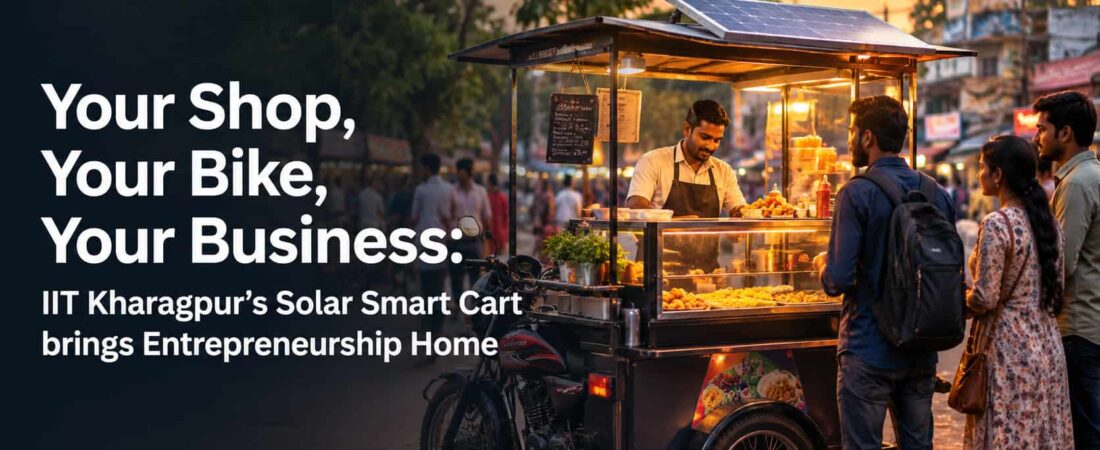
The press photographs show the IIT Kharagpur Solar Smart Cart branded Nagar Udyam – Tea & Snacks, with a lit signboard, a glass-fronted food display and a printed menu board. It looks like a compact shop, built to be moved.
Here is an illustrative example, not taken from the release. A tea seller could serve office-goers near a bus stop in the morning, then shift to a college event in the evening, without paying rent for a fixed shop. The release itself uses careful wording, saying a vendor could potentially work this way.
Director Chakraborty said the aim is “to redesign the opportunity around the person who runs it.” For someone who cannot afford a permanent shop, the release frames this as a micro-startup route that may, over time, help create jobs for others. That is an ambition, not a guaranteed outcome.
Students and first-time entrepreneurs may also find the training and record-keeping angle useful. If you want to build skills alongside, CareerView24’s guide to SWAYAM July semester registration covers 662 online-course exams, including Employability Skills.
The release speaks of Kharagpur and a future West Bengal framework. It does not mention rural rollout, so whether the model suits villages or smaller towns is untested.
Why Public Space Is Part of the Story
Street vending often sits uneasily with pedestrian space. SDPO Dangi’s remarks in the release accept both sides: livelihoods and public safety must be protected together. He suggested that a mobile, identifiable and responsibly run unit could reduce permanent obstruction, but said disciplined implementation, safe movement and compliance with local rules will decide the outcome.
That is the practical idea behind the IIT Kharagpur Solar Smart Cart: treating a vendor’s income and a free footpath as compatible goals. The release itself adds that these benefits depend on traffic safeguards, lawful operating locations and coordination with civic authorities.
What Is Still Unknown
Because this is a pilot announcement, several practical questions remain open. The release does not state:
- the price of a cart, or who would fund it
- solar panel capacity, battery size or operating hours
- whether the 30 km range has been proven on real roads
- which licences, parking rules and towing permissions would apply
- when, or how, vendors outside the campus could get one
- whether vendors’ incomes actually improve
We have not tried to guess these answers. Anyone considering such a cart should wait for official specifications and check local vending rules first.
What the Pilot Will Test
IIT Kharagpur will use its campus as the first test bed for the IIT Kharagpur Solar Smart Cart through SETU Cloud Kitchen Connect. The pilot will evaluate food safety, operational efficiency, environmental performance, mobility, vendor experience and consumer response.
Findings are meant to inform a prospective West Bengal Smart Street Vendor Framework, covering cart standards, food-safety practices, space management and measurable social outcomes. The pilot stall is also linked to the Institute’s wellbeing initiative, with the amounts it generates directed towards human-centric development.
Why This Matters for India
Small street businesses often struggle with storage, record-keeping and regulation, though the picture varies by city. What stands out here is the combination: a physical cart, a digital identity layer and a policy framework being tested together.
A cart alone cannot fix rising ingredient costs, competition or licensing delays. Its value will depend on how well the pilot data shapes real rules and whether vendors find it affordable. That is why this story deserves attention, and also patience.
Frequently Asked Questions
1. What is the IIT Kharagpur Solar Smart Cart?
It is a convertible, three-wheeler-inspired vending cart under IIT Kharagpur’s Nagar Udyam pilot. It is designed to be towed by a motorcycle, stored at home and supported by solar-battery power and a digital platform.
2. Is it fully solar-powered?
Not according to the release. It describes a compact solar and battery arrangement for essential low-power functions only.
3. Can I buy one now?
No commercial availability or price has been announced. The cart is in a campus pilot.
4. How far can it travel?
It is designed around movement of approximately 30 km, subject to operational and road-safety validation.
5. Who is it meant for?
Street vendors and small entrepreneurs, especially people who cannot afford a permanent shop. Eligibility and access rules have not been announced.
Final Takeaway
The IIT Kharagpur Solar Smart Cart is best seen as a promising pilot, not a finished product. Its core idea is simple and human: let a vendor carry the business to customers and bring it home safely. The next test is whether the campus results translate into affordable, safe and lawful vending on real streets.