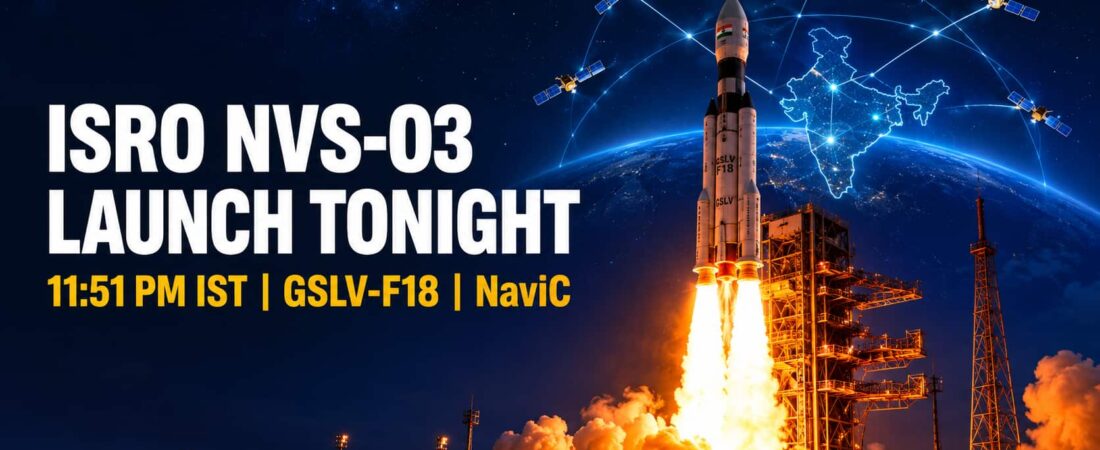
ISRO NVS-03 Satellite Launch 2026: Tonight at 11:51 PM, GSLV-F18 Aims to Strengthen India’s NavIC
Just minutes before midnight tonight, ISRO will try to strengthen the satellites that tell India where it is and what time it is. The ISRO NVS-03 Satellite Launch 2026 is scheduled for 11:51 PM IST on 30 October 2026, when the GSLV-F18 rocket is due to lift off from Sriharikota in Andhra Pradesh.
Published: 30 October 2026 | Source: Akashvani News
Key Takeaways
ISRO plans to launch NVS-03 aboard GSLV-F18 on 30 October 2026 at 11:51 PM IST.
Liftoff is planned from the Second Launch Pad, Satish Dhawan Space Centre, Sriharikota.
This will be the 20th flight of the GSLV, and the satellite will go to Geosynchronous Transfer Orbit (GTO).
NVS-03 is the third second-generation NavIC satellite. It carries an indigenous atomic clock alongside procured ones.
NavIC covers the Indian mainland and up to 1,500 km beyond its borders.
NVS-04 and NVS-05 are the next missions meant to stabilise India’s navigation capabilities further.
ISRO NVS-03 Satellite Launch 2026: Latest Update
ISRO has announced that the GSLV-F18/NVS-03 mission is scheduled for 30 October 2026 at 23:51 hrs IST from the Satish Dhawan Space Centre in Sriharikota. The satellite will be placed into a Geosynchronous Transfer Orbit.
Everything here is a plan, not a result. Launches can shift because of technical or weather checks, so treat the ISRO NVS-03 Satellite Launch 2026 as scheduled until ISRO itself confirms the outcome.
There is some history behind the interest too. NVS-02 lifted off in January 2025 but was later reported stranded in transfer orbit after a valve malfunction. That adds to the attention on tonight’s ISRO NVS-03 Mission.
Watch: DD India’s report on the GSLV-F18/NVS-03 mission.
NVS-03 Launch Date, Time and Launch Location
The NVS-03 launch date is 30 October 2026, and the NVS-03 launch time is 11:51 PM IST. The rocket will lift off from the Second Launch Pad at the Satish Dhawan Space Centre in Sriharikota, Andhra Pradesh.
Because liftoff is close to midnight, many readers will learn the result only the next morning. TheISRO official websiteand its social channels are the most reliable places for first confirmation.
What Is the NVS-03 Satellite and Why Is It Important?
NVS-03 is an Indian navigation satellite and the third in the second-generation NavIC series. Akashvani News describes it as designed to maintain and boost the continuity of the NavIC system.
It is part of a larger plan. Five second-generation NavIC satellites, NVS-01 to NVS-05, are envisaged to augment the NavIC base constellation. The first, NVS-01, flew on GSLV-F12 in May 2023 and was the first to carry an indigenous atomic clock.
So this Indian navigation satellite is not a standalone experiment. It is one step in a planned series meant to keep NavIC running without a break.
What Is India’s NavIC Navigation System?
NavIC stands for Navigation with Indian Constellation. It is India’s independent regional navigation satellite system, built to give users accurate Position, Velocity and Timing services across India and about 1,500 km beyond the Indian landmass.
ISRO describes two types of service. The Standard Positioning Service is for civilian users, while the Restricted Service is an encrypted service for authorised users.
This is what “India’s indigenous navigation system” means in practice. GPS is operated by the United States, whereas NavIC is designed, launched and run by India. It is also regional by design, meaning it focuses on India and its neighbourhood rather than the whole world.
Key Features of NVS-03, Including Its Indigenous Atomic Clock
Indigenous atomic clock
Navigation satellites work by broadcasting extremely precise time signals. A receiver compares signals from several satellites, and even a tiny timing error can turn into a large position error. That is why atomic clocks sit at the heart of every navigation satellite.
NVS-03 carries an indigenous atomic clock alongside procured ones. Akashvani News says this is meant to enhance precise positioning.
L1 signal
According to ISRO, as reported by IANS, the satellite incorporates the L1 navigation signal in addition to the existing L5 and S signals. In simple terms, it adds another signal to the mix, which is expected to enhance the system’s navigation capabilities.
How Will the GSLV-F18 Mission Strengthen India’s Navigation Capabilities?
GSLV stands for Geosynchronous Satellite Launch Vehicle, ISRO’s rocket for carrying heavier satellites towards high orbits. The GSLV-F18 rocket will be the 20th flight of this family.
The rocket’s job is to deliver NVS-03 to Geosynchronous Transfer Orbit, an elongated orbit that works as a stepping stone. The satellite then uses its own propulsion to move towards its working position. That later phase is where NVS-02 ran into trouble in 2025.
The payoff is the numbers. Akashvani News reports that a successful deployment would restore NavIC’s basic operational requirement to four satellites. For India, a steadier NavIC means less reliance on foreign systems for positioning and timing.
Every GSLV flight also adds experience with a rocket that has become the carrier of choice for this navigation series.
What Comes Next? NVS-04 and NVS-05 Missions
NVS-03 is not the finish line. Akashvani News says its deployment lays the groundwork for the upcoming NVS-04 and NVS-05 launches, which are intended to fully stabilise India’s independent navigation capabilities.
Dates for these two missions were not part of the announcement, so it is best to wait for ISRO’s own notices.
For exam aspirants: remember the NavIC full form, the 1,500 km coverage, the GSLV-F18 as the 20th GSLV flight, and the “third second-generation satellite” tag for NVS-03. Questions on these points are easy to expect.
Frequently Asked Questions
1. When is the ISRO NVS-03 Satellite Launch 2026 scheduled?
It is scheduled for 30 October 2026 at 11:51 PM IST.
2. Which rocket will carry NVS-03, and from where?
The GSLV-F18 will carry it from the Second Launch Pad at the Satish Dhawan Space Centre, Sriharikota, Andhra Pradesh.
3. What is the NVS-03 satellite?
It is the third second-generation NavIC satellite, designed to maintain and improve the continuity of India’s navigation system. It carries an indigenous atomic clock alongside procured ones.
4. What is NavIC and how far does it cover?
NavIC is India’s independent regional navigation system. It provides positioning, navigation and timing services across the Indian mainland and up to 1,500 km beyond India’s borders.
5. Has NVS-03 been launched successfully?
Not confirmed at the time of writing. The launch was scheduled for tonight, and readers should rely on ISRO’s official announcements for the outcome.
Conclusion
The ISRO NVS-03 Satellite Launch 2026 is more than another night launch from Sriharikota. It is a step towards keeping India’s own navigation system dependable, with an indigenous atomic clock on board and a planned follow-up in NVS-04 and NVS-05.
Until ISRO confirms the result, the safest reading is that the mission is planned and promising, not yet proven. Whatever the outcome, the direction is clear. India wants to own the technology that tells it where it is and what time it is.