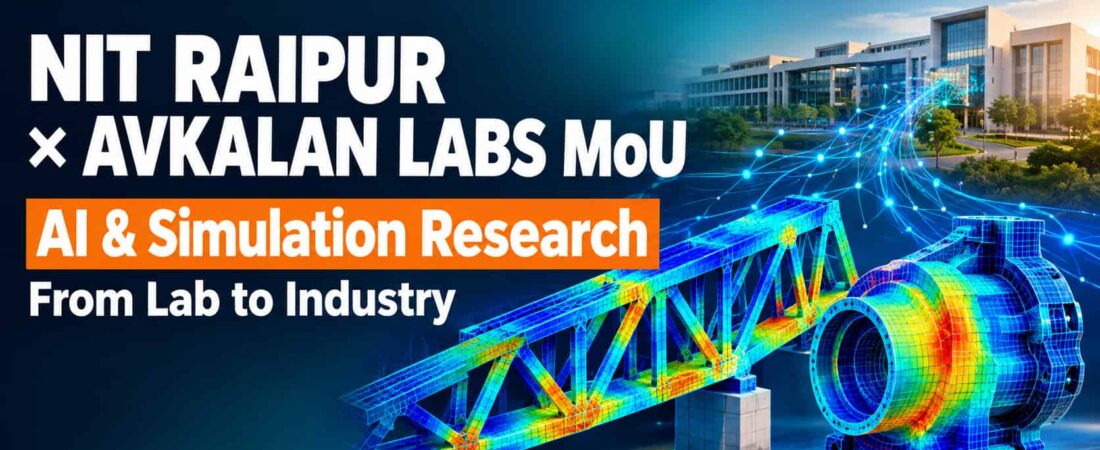
NIT Raipur has teamed up with a deep-tech startup that set up its operational base in the city only last year, with a clear goal: take engineering research out of the laboratory and put it to work in industry. The NIT Raipur Avkalan Labs MoU, announced by the Press Information Bureau (PIB) on 23 October 2026, links the institute with Avkalan Labs Private Limited to advance computational engineering, advanced simulation and artificial intelligence (AI).
For engineering students and research scholars, the agreement matters because it creates a framework for industry-linked training, projects and sponsored postgraduate research. It is not, however, a recruitment or admission notice, and no individual opportunity has been announced.
 Written by Shashank Shekhar Dwivedi | Updated: 24 October 2026 | Source: Press Information Bureau (PIB)
Key Takeaways
- NIT Raipur and Avkalan Labs Private Limited signed an MoU, announced in a PIB release dated 23 October 2026.
- The stated aim is to apply computational engineering, advanced simulation and AI to engineering disciplines at an industrial scale.
- Both institutions will pursue joint research, industrial training, student internships and academic projects.
- The agreement sets a framework for industry-sponsored M.Tech and Ph.D. research, which may lead to joint publications, patents and commercialisation.
- A Centre of Excellence in Computational Mechanics is only being explored and is not yet confirmed.
- No application process, vacancies, stipend or seat numbers have been announced.
What Is the NIT Raipur Avkalan Labs MoU?
A Memorandum of Understanding (MoU) is a formal document outlining the areas in which two organisations intend to work together. This one connects a National Institute of Technology with a startup, and its primary objective, according to the PIB, is to advance the practical application of computational engineering, advanced simulation technologies and AI in engineering disciplines.
Put simply, the idea is to let expertise developed in laboratories be deployed at an industrial scale. The release was issued by PIB Raipur under the Ministry of Education.
Avkalan Labs is described as a deep-tech startup that originated as an incubatee at IIT Roorkee and relocated its operational base to Raipur in 2025. The PIB says the collaboration will help strengthen the local research and deep-tech innovation ecosystem in Chhattisgarh.
Who Signed the Agreement?
The MoU was signed by Dr. N. V. Ramana Rao, Director of NIT Raipur, and Dr. Kamal Shankar Patel, Director and Co-founder of Avkalan Labs.
The signing ceremony was attended by Prof. Gangadhar Ramtekkar and Prof. Shirish V. Deo of the Department of Civil Engineering, and Prof. S. Sanyal of the Department of Mechanical Engineering.
All joint activities under the agreement will be coordinated under the supervision of Prof. Ramtekkar, Dr. Mohit Jaiswal, Assistant Professor in the Department of Civil Engineering, and Dr. Patel.
Research Areas Covered Under the Partnership
The PIB names computational mechanics, finite element analysis and multiphysics simulation as high-tech domains for joint work, alongside advanced simulation and AI. The explanations below are editorial context, not text from the release.
- Computational mechanics: using computer models to study how materials, structures and machines respond to forces, heat and motion, instead of relying only on physical tests.
- Finite element analysis (FEA): a method that divides a complex object, such as a bridge or machine part, into many small elements so engineers can estimate stress, deformation and failure risk.
- Multiphysics simulation: models in which several physical effects, such as heat, fluid flow and structural load, influence one another at the same time.
- Artificial intelligence: software that learns patterns from data and can help speed up simulations or search for better designs. The release does not specify which AI methods will be used.
The proposed centre’s focus areas, structural mechanics, engineering optimization and high-performance computing, build on these methods.
What Could It Mean for Students and Researchers?
Under the partnership, both institutions will pursue joint research, industrial training, student internships and academic projects. The agreement also establishes a framework for industry-sponsored M.Tech and Ph.D. research that addresses real-world industry challenges.
According to the PIB, this paves the way for joint research publications, patent filings and the commercialisation of new technologies. These are intended directions, not guaranteed outcomes.
The key point for readers is that the NIT Raipur Avkalan Labs MoU confirms a framework, not a set of ready opportunities. The release does not announce any recruitment, vacancy, scholarship, application link, deadline, number of internship seats, stipend, eligibility criteria or admission process.
If put into practice, the framework could give students closer exposure to industry problems and simulation tools, but that depends on decisions yet to be announced. Students comparing institutions can also read CareerView24’s guide to the top engineering colleges in India 2026.
Proposed Centre of Excellence at NIT Raipur
A key dimension of the collaboration is exploring the potential establishment of a dedicated Centre of Excellence in Computational Mechanics at NIT Raipur. The proposed centre aims to serve as a platform for advanced research, specialised skill training and the development of modern computational methodologies.
It is also meant to give students direct, hands-on exposure to practical engineering challenges.
Importantly, the wording is about exploring a possibility. The release gives no launch date, budget, location on campus or timeline, so the centre should not be treated as confirmed or operational.
Why Industry-Academia Collaboration Matters
Engineering problems often need both academic depth and practical data: institutes bring research methods and trained scholars, while companies bring real-world problems.
Avkalan Labs’ Raipur base adds a regional angle. The PIB says the partnership is set to nurture skilled technical talent, expand local technological capabilities and apply academic expertise to India’s broader industrial and societal growth.
Such partnerships take time to show results, and outcomes vary. For a recent example of another institute working with industry and a government-backed society on a research trial, read CareerView24’s report on the IIT Gandhinagar quantum communication link, which involved IIT Gandhinagar, BISAG-N and QNu Labs.
How to Follow Official Updates
For verified information, read the official PIB announcement and visit the NIT Raipur website for institute notices.
The PIB release does not link to any separate application page from NIT Raipur or Avkalan Labs. Students should avoid forms or messages claiming to offer internships or admissions under this MoU unless they come from official channels.
Frequently Asked Questions
1. What is the NIT Raipur Avkalan Labs MoU about?
It is an agreement to advance computational engineering, advanced simulation and AI through joint research, training, internships, academic projects and industry-sponsored postgraduate research.
2. When was the MoU announced?
PIB Raipur published the release on 23 October 2026 at 6:21 PM. The release does not state the exact signing date.
3. Which research areas are covered by the partnership?
The PIB mentions computational mechanics, finite element analysis and multiphysics simulation, along with advanced simulation and AI.
4. Will students get internships or M.Tech and Ph.D. research opportunities?
The MoU says both sides will pursue student internships and sets a framework for industry-sponsored M.Tech and Ph.D. research. Specific openings, seats, eligibility and application details have not been announced.
5. Has NIT Raipur confirmed a Centre of Excellence?
Not yet. The release says the potential establishment of a Centre of Excellence in Computational Mechanics is being explored. No timeline has been shared.
What to Watch Next
The NIT Raipur Avkalan Labs MoU confirms a formal partnership between an NIT and a deep-tech startup to bring AI, computational mechanics and simulation closer to real industrial use. It sets out a framework for joint research, training, internships, academic projects and sponsored M.Tech and Ph.D. work.
What happens next will decide its real value. Students and researchers should watch for official announcements on specific projects, internship details, sponsored research topics and any decision on the proposed Centre of Excellence, and rely only on NIT Raipur and PIB for