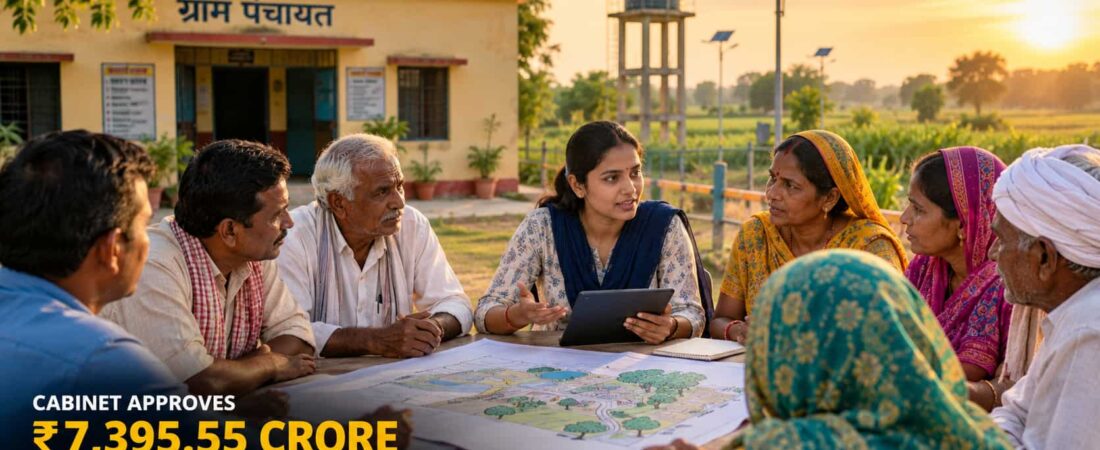
The Union Cabinet has cleared a ₹7,395.55 crore plan to make village governance in India stronger. Chaired by Prime Minister Narendra Modi, the Cabinet approved the Pradhan Mantri Viksit Gram Swaraj Yojana (PM VGSY), a Centrally Sponsored Scheme. Under PM Viksit Gram Swaraj Yojana 2026, the money will be spent over five years, from 2026–27 to 2030–31.
The focus is on Panchayats: better planning, training for local representatives, audits and clearer public communication, as reported by DD News from a PIB release.
One thing to clear up early: this is not a job notification, and it is not a cash scheme for households. It is about helping village-level institutions work better.
 Written by Shivam Kumar | Author & Editor, CareerView24 | Updated: 28 October 2026 | Source: DD News
Table of Contents
Key Takeaways
- Approved by: Union Cabinet, chaired by PM Narendra Modi
- Total outlay: ₹7,395.55 crore (Centre ₹4,869.48 crore; States ₹2,526.07 crore)
- Period: 2026–27 to 2030–31, in line with the Sixteenth Finance Commission period
- Direct beneficiaries: about 32 lakh elected representatives, Panchayat functionaries and other stakeholders
- Coverage: more than 2.55 lakh Panchayats and Traditional Local Bodies
- Core tools: eGramSwaraj Portal, AuditOnline and the PANCHAM AI platform
- Recruitment: no permanent posts will be created, and there is no individual application process
What Is PM Viksit Gram Swaraj Yojana 2026?
PM VGSY is a Centrally Sponsored Scheme that aims to make Gram Panchayats stronger centres of local governance. “Centrally Sponsored” means the Centre and the States share the cost.
The Gram Panchayat is the village-level body in the Panchayati Raj system, which is overseen at the national level by the Ministry of Panchayati Raj. It plans local works, uses public funds and works with government departments. Students who want to understand how the three tiers fit together can read our explainer on [the Panchayati Raj system](ADD URL), which covers the constitutional background asked in many exams.
PM VGSY targets the weak points of this system. As reported, it focuses on participatory planning, coordination among departments, capacity building and transparent use of resources. It is a systems-and-skills scheme for local institutions, not a benefit scheme for individual households.
Cabinet Approval and Total Budget
The Cabinet cleared a total outlay of ₹7,395.55 crore, shared between the Centre and the States as follows.
| Component | Amount (₹ crore) |
|---|---|
| Central share | 4,869.48 |
| State share | 2,526.07 |
| Total outlay | 7,395.55 |
The Centre bears roughly two-thirds of the cost and the States about one-third. Some headlines round the total to ₹7,395 crore, but the official figure is ₹7,395.55 crore.
This is the approval of the scheme and its financial framework. Detailed operational guidelines were not part of the source report. Readers tracking other recent approvals can check our roundup of [latest Cabinet decisions](ADD URL).
Who Will Benefit From the Scheme?
According to the government, the scheme will directly benefit about 32 lakh elected representatives, Panchayat functionaries and other stakeholders across more than 2.55 lakh Panchayats and Traditional Local Bodies.
It helps to separate three groups:
- Institutions: Gram Panchayats and Traditional Local Bodies receive support for planning, audits and communication.
- Functionaries: elected representatives and Panchayat staff receive capacity-building support.
- Citizens: villagers are expected to benefit indirectly through better planning and awareness. Each coordinated awareness exercise is expected to reach at least one crore citizens.
“Beneficiary” here means a participant in training and institutional strengthening. It does not mean someone who will receive money. No direct cash benefit, subsidy or household payment has been announced.
Main Objectives and Key Features
The scheme has six stated aims:
- Participatory planning: village-level priorities feed into development plans.
- Local development priorities: national goals are matched to local needs.
- Departmental coordination: schemes and resources are brought together at the Panchayat level.
- Capacity building: training in planning, citizen communication, resource management and locally relevant Sustainable Development Goals.
- Transparent use of resources: better use of funds, including Finance Commission grants.
- Financial accountability: improved accounting, public disclosure and mobilisation of Panchayats’ own-source revenue, which is expected to promote greater self-reliance.
Gram Panchayat Development Plans, eGramSwaraj and AuditOnline
Planning: The scheme provides for at least 2.55 lakh comprehensive Gram Panchayat Development Plans (GPDPs) every year, prepared through the eGramSwaraj Portal. Each plan brings together village priorities, available government schemes and local resources, so spending is guided by identified needs.
Audit: For accountability, the scheme supports at least 2.55 lakh online audit plans annually and the timely completion of the corresponding audits through AuditOnline. In plain terms, Panchayat accounts are meant to be planned, audited and disclosed in a more structured digital way.
These are stated targets, not results. The actual outcome will depend on how well States and Panchayats carry them out.
Role of PANCHAM AI Platform
The government will use PANCHAM, an AI-enabled multilingual communication platform available in 17 Indian languages, to explain schemes and initiatives in accessible language.
Its intended role is public awareness. It will work alongside existing digital and outreach platforms, Gram Sabhas and other Panchayat forums. The source describes it as a communication tool, so it should not be read as a service that delivers benefits or processes applications.
Implementation Period and States Covered
The scheme runs from 2026–27 to 2030–31. It covers all States and Union Territories, including traditional rural local government institutions in areas where Panchayats do not exist under Part IX of the Constitution.
Implementation will be through State Governments and UT Administrations. They will submit annual action plans outlining activities, priorities and requirements. A designated Central Empowered Committee will appraise and approve these plans.
Is There Any Government Job or Online Application?
No. PM Viksit Gram Swaraj Yojana 2026 is not a recruitment notification, and there is no individual application process.
- Permanent jobs: no permanent posts will be created under the scheme.
- Contractual roles: need-based contractual personnel may be engaged at State, district and block levels for technical support and implementation. No vacancy numbers, eligibility criteria or application dates have been announced.
- Citizen applications: there is no application form or portal for individuals.
Job aspirants should ignore social media posts claiming “vacancies” or “registration” under this scheme. Genuine openings are listed on our [latest government jobs page](ADD URL), and any future contractual engagement would be announced by the concerned State or district authority.
Why Is This Scheme Important for Rural Development?
Panchayats handle local planning, but weak data, limited training and patchy audits can hold back results. PM VGSY addresses these gaps in a structured way.
The expected benefits include:
- Better planning: development plans prepared on a common digital platform.
- Greater transparency: regular audits and public disclosure.
- Local participation: Gram Sabhas and Panchayat forums used for awareness and planning.
- Efficient use of funds: Panchayats helped to use Finance Commission grants and other resources better.
These are the government’s stated expectations, not guaranteed outcomes. Results will depend on State-level execution, local capacity and monitoring over the five-year period.
For exam aspirants, this is a useful current-affairs item. Note the scheme name, outlay, Centre-State split, period, the three digital tools and the no-permanent-posts clause. Our [government schemes current affairs](ADD URL) section collects similar topics for revision.
Explore another Central Government scheme, its objectives, eligibility criteria and benefits for students.
Frequently Asked Questions
1. What is PM Viksit Gram Swaraj Yojana 2026?
PM Viksit Gram Swaraj Yojana 2026 refers to the Centrally Sponsored Scheme approved by the Union Cabinet to strengthen grassroots governance. It focuses on Panchayat planning, capacity building, audits and public awareness.
2. What is the total budget of PM Viksit Gram Swaraj Yojana?
The total outlay is ₹7,395.55 crore, with a Central share of ₹4,869.48 crore and a State share of ₹2,526.07 crore.
3. Who will benefit from PM Viksit Gram Swaraj Yojana?
About 32 lakh elected representatives, Panchayat functionaries and other stakeholders across more than 2.55 lakh Panchayats and Traditional Local Bodies. It does not provide direct cash benefits to households.
4. Is PM Viksit Gram Swaraj Yojana a government job scheme?
No. No permanent posts will be created. Need-based contractual technical personnel may be engaged at State, district and block levels, but no vacancies have been announced.
5. What is the implementation period of PM Viksit Gram Swaraj Yojana?
2026–27 to 2030–31, in line with the Sixteenth Finance Commission period.
Conclusion
The approval of PM Viksit Gram Swaraj Yojana 2026 puts ₹7,395.55 crore behind better planning, training, audits and communication at the Panchayat level over five years. The scheme invests in institutions rather than offering individual benefits, and its success will depend on implementation in the States.
For guidelines, State action plans and any future announcements, readers should rely on the Ministry of Panchayati Raj, the Press Information Bureau (PIB) and State government notifications.