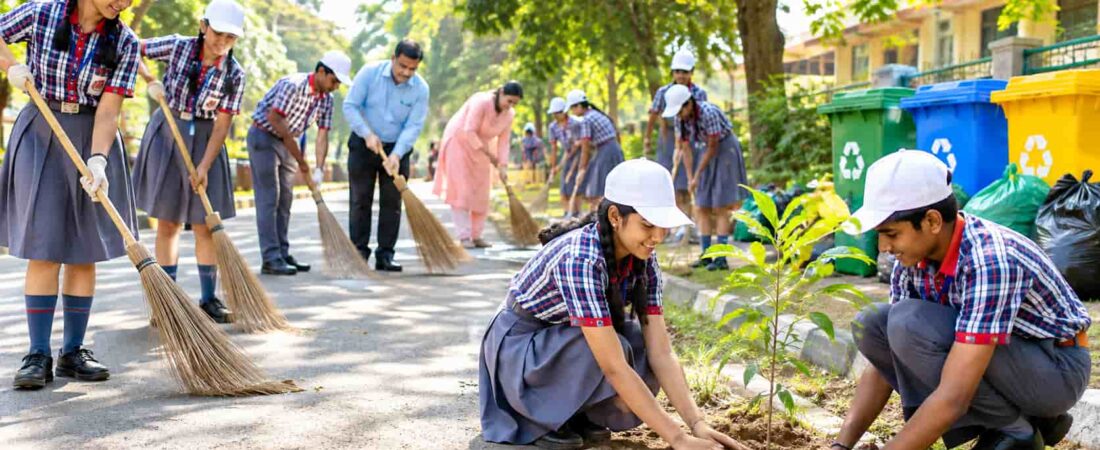
Swachhata Hi Seva 2026 began like any other school morning in New Delhi, until the Secretary of School Education walked in, not with a file, but with a broom.
On 1 October 2026, he joined students in checked uniforms and white caps to sweep the road outside their school. No stage, no long speeches. Just brooms, bags of waste and a lot of curious kids.
Table of Contents
What Happened at the Swachhata Hi Seva 2026 Shramdaan
The Department of School Education and Literacy (DoSEL), under the Union Ministry of Education, organised a Swachhata Shramdaan at a PM SHRI school in the capital. The campaign is a nationwide push to make cleanliness a shared habit rather than an occasional chore.
Leading from the front was Shri T. K. Anil Kumar, Secretary, DoSEL. Students, teachers, senior officials and officers of the Kendriya Vidyalaya Sangathan (KVS) joined him, so everyone from the classroom bench to the ministry corridors worked on the same ground.
The drive was held under the aegis of Eco Clubs for Mission LiFE. Mission LiFE stands for Lifestyle for Environment, an idea built on a simple belief: small everyday choices, repeated by millions of people, can change the planet’s direction. School Eco Clubs are one way that belief reaches children early.
Read the official PIB release on the Swachhata Hi Seva 2026 activity at the PM SHRI School.
Cleanliness That Didn’t Stop at the School Gate
Many cleanliness drives end where the school wall ends. This one deliberately didn’t. The effort covered three spaces:
- the school campus
- an adjoining community space
- the park in front of the school
By stepping outside the gates, the programme brought the school and its neighbourhood together. The message was quiet but clear: a clean locality isn’t one institution’s job, it belongs to everyone who uses it.
The photographs capture this well. In one, students and officials pose together on a green mat, with bags of collected waste stacked beside them and colour-coded dustbins lined up at the side. In another, adults in white caps sweep a tree-lined road, fallen leaves gathering along the yellow-and-black kerb.
After the Brooms, the Saplings
Once the sweeping was done, the day moved from cleaning to growing. A tree plantation programme followed under ‘Ek Ped Maa Ke Naam 3.0’, which invites people to plant a tree in honour of their mother.
There’s something touching about that idea. A mother gives life and care, and a tree does the same quietly for years. Planting one in her name joins gratitude and environmental responsibility in a single act.
One photograph shows an official watering a freshly planted sapling with a green can while students in uniform stand beside him, watching closely. Stones circle the young plant. It’s a small scene, but children remember what they do with their own hands. Years from now, some of them may walk past that tree and remember who planted it, and why.
A Quiz That Made Rules Feel Like a Game
The third part of the programme may have been the cleverest: a quiz on the Solid Waste Management Rules.
On paper, those rules sound heavy and technical. Turned into questions and answers, they become a game. The goal was to help students understand source segregation, which simply means separating waste where it is created, and the importance of responsible waste disposal.
In the photographs, a presenter addresses rows of seated students, many leaning forward, ready to answer. That’s what interactive learning looks like: not a lecture to sit through, but a conversation to join.
It matters for a practical reason too. Children who learn to separate wet and dry waste at school often carry the habit home, and sometimes end up teaching their parents.
Students are using AI for notes, research, exam preparation and smarter learning. Explore the Top AI Tools Students Are Using in 2026 and discover useful tools for everyday studies.
Explore AI Tools for Students →Why Swachhata Hi Seva 2026 Begins in Schools
The central idea behind Swachhata Hi Seva 2026 was the role of schools in shaping clean, sustainable and environmentally responsible habits from a young age. By inviting students to take part rather than just watch, the programme encouraged them to contribute actively to cleanliness and conservation.
It also reinforced DoSEL’s commitment to making Swachhata part of everyday life, supporting the vision of a Swachh and Viksit Bharat, a clean and developed India.
Habits formed in childhood tend to last. A student who learns today that a wrapper belongs in a bin, not on the ground, is far more likely to grow into a citizen who cares tomorrow.
For more updates on Swachhata Hi Seva 2026, visit the official Department of School Education & Literacy website. Department of School Education & Literacy
The Officials Who Joined In
Alongside the Secretary, several senior DoSEL officials took part:
- Shri Dheeraj Sahu, Additional Secretary
- Ms. Archana Sharma Awasthi, Additional Secretary
- Ms. Prachi Pandey, Joint Secretary
- Dr. Amarpreet Duggal, Joint Secretary
- Dr. Pankaj K. P. Shreyaskar, Deputy Director General (Statistics)
- Ms. Deepika Jain, Chief Controller of Accounts
- Shri Vikas Gupta, Commissioner, Kendriya Vidyalaya Sangathan
Officers from KVS joined them as well. Seeing people who usually shape policy from behind desks sweep roads beside schoolchildren sends a message no speech could: this work is for everyone, and leaders are not exempt.
Students, teachers, senior officials and officers of the Kendriya Vidyalaya Sangathan (KVS) joined him, all working on the same ground.
Three Takeaways Worth Keeping
1. Leadership is shown, not announced. When senior officials do the work themselves, the message travels further than any poster.
2. Cleaning and greening go together. Sweeping a park and planting a tree in the same morning shows that reducing waste and growing nature are two halves of one effort.
3. Learning sticks when it’s lived. A quiz, a sapling and a broom gave students a full experience, not just a textbook chapter.
Try It Closer to Home
You don’t need an official campaign to begin. A few small steps can start today:
- keep separate bins for wet and dry waste at home
- plant a tree in your mother’s name and look after it
- invite neighbours to tidy a nearby park or shared space
- turn waste segregation into a fun challenge for children
Final Thoughts
At heart, this was a simple morning: a few brooms, a handful of saplings, a quiz and a lot of children eager to help. But simple things, done together and led by example, are often what change habits for good.
Swachhata Hi Seva 2026 reminds us that change doesn’t wait for a grand stage. Sometimes it starts in a school courtyard, with a child watching an adult do the right thing.
So the next time a clean-up or planting drive happens near you, don’t just watch from the sidelines. Pick up a broom or a sapling, and let someone younger see you do it.
Enjoyed this story from schools? If you or your child are interested in talent programs beyond the classroom, check this Nationwide Sports Talent Hunt update from CareerView24.
Read Nationwide Sports Talent Hunt →Frequently Asked Questions (FAQs)
Q1. What is Swachhata Hi Seva 2026?
It’s a nationwide cleanliness campaign that asks everyone to make cleanliness a daily habit, not a one-day event. This time, schools were at the heart of it.
Q2. Who led the Shramdaan at the PM SHRI school?
Shri T. K. Anil Kumar, Secretary, DoSEL, picked up the broom himself. Students, teachers, senior officials and KVS officers worked right beside him.
Q3. What happened during the event?
Three things: a clean-up of the school, a nearby community space and the park outside, then tree planting under ‘Ek Ped Maa Ke Naam 3.0’, and finally a fun quiz on the Solid Waste Management Rules.
Q4. What is the Eco Clubs for Mission LiFE connection?
The drive ran under Eco Clubs for Mission LiFE. These school clubs help children build small green habits, like separating waste and caring for plants.
Q5. Why does Swachhata Hi Seva 2026 focus on schools?
Because kids learn fast and take habits home. A child who learns to use the right bin today often teaches the whole family tomorrow.