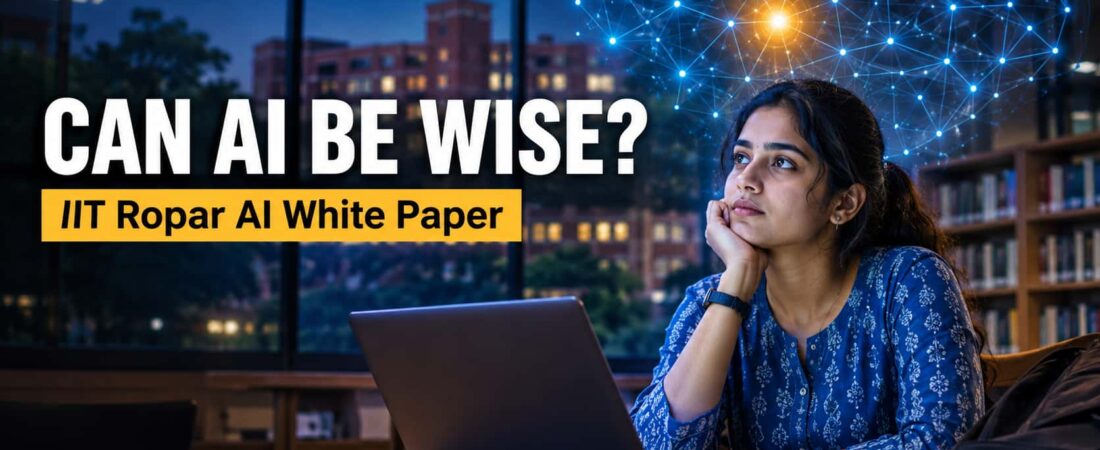
It is 11 pm, the exam is at nine, and a student types a question into an AI chatbot. The answer arrives in seconds, fluent and completely sure of itself. But is it right? And would the student even know?
That question is the starting point of the new IIT Ropar AI White Paper. Titled “Beyond Intelligence: Defining and Measuring Wisdom for AI”, the paper examines how artificial intelligence can be tested for wisdom, not just intelligence.
So can AI become wise, or is being intelligent enough? The White Paper’s starting point is that intelligence alone is not the whole test.

Key Takeaways
- IIT Ropar has launched a White Paper, “Beyond Intelligence: Defining and Measuring Wisdom for AI”, on testing AI for wisdom and not just intelligence, as reported by Akashvani News.
- It was launched by IIT Ropar Director Prof Rajeev Ahuja and Dr Ishan Shivanand, and co-authored with Dr Anjali Samani.
- Dr Shivanand says the aim is wiser AI that helps people strengthen their own discernment.
- It is a White Paper, not a government policy and not a new AI model.
Direct Answer: What Has IIT Ropar Launched?
IIT Ropar has launched a White Paper on how artificial intelligence can be tested for wisdom, not only for intelligence. Akashvani News reports that it is co-authored by Dr Ishan Shivanand, Director of Research at Stanford University and Adjunct Faculty at IIT Ropar, and Dr Anjali Samani, a former AI and data science executive at Salesforce.
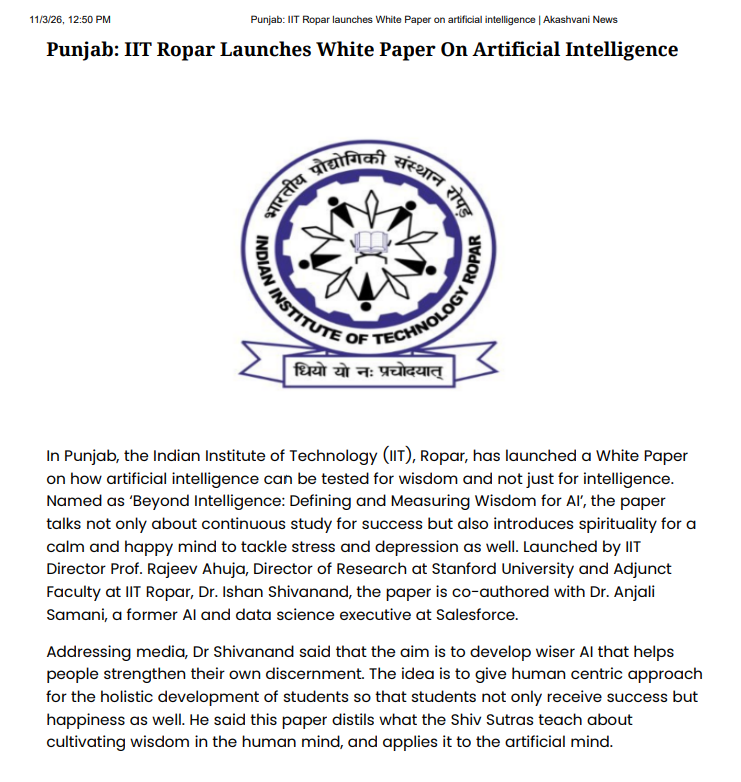
The report describes a paper, not a product. The IIT Ropar AI White Paper is not described as a new AI model.
What Is the ‘Beyond Intelligence’ White Paper?
A White Paper is a report that sets out a problem and proposes a way of thinking about it. This one asks how wisdom in AI could be defined and measured, as its title says.
Akashvani adds a second thread. The paper, it says, talks not only about continuous study for success but also introduces spirituality for a calm and happy mind, to tackle stress and depression. So the paper looks at the human learner as well as the machine.
One honest limit: we could not find the full text of the paper online, and the report does not explain how wisdom would be measured. This article sticks to what the report states. Where we go further, we say so.
Why Does AI Need Wisdom Beyond Intelligence?
In this discussion, intelligence is the ability to know things and solve problems. Wisdom is using that knowledge with sound judgement, for the real benefit of the person asking.
Think of two people at a railway station. One can recite the timetable. The other knows which platform to run to when the announcement changes, and when to simply ask. Only one is wise in the moment.
That example is ours, not the paper’s. It explains why a system can score brilliantly on knowledge and still be a risky guide. Fluent and correct are not the same thing, and a confident wrong answer can be more misleading than a hesitant one.
Here Dr Shivanand’s stated aim, becomes interesting. He said the goal is to develop wiser AI that helps people strengthen their own discernment. Notice what this does not say. It does not ask AI to think for us. It asks AI to help us think better.
That is the heart of human-centric AI: not just how much a system knows, but whether its user becomes sharper rather than more dependent.
Who Is Behind the White Paper?
IIT Ropar and Prof Rajeev Ahuja. IIT Ropar, one of the newer IITs set up in 2008, is the host institution. Akashvani names its Director, Prof Rajeev Ahuja, among those who launched the paper.
Dr Ishan Shivanand. Akashvani describes him as Director of Research at Stanford University and Adjunct Faculty at IIT Ropar.
Dr Anjali Samani. She co-authored the paper and is described as a former AI and data science executive at Salesforce.
What Do Shiv Sutras Have to Do With Artificial Intelligence?
Dr Shivanand said the paper distils what the Shiv Sutras teach about cultivating wisdom in the human mind, and applies it to the artificial mind.
The Shiv Sutras are a classical Indian text from the Shaiva tradition. The report does not list which teachings the paper uses, so we cannot say more about the details.
Our reading: India has a long tradition of studying how the mind becomes calm, clear and discerning. The connection between Shiv Sutras and artificial intelligence brings a fresh perspective to a subject usually discussed through engineering and regulation. It highlights why wisdom, mental clarity and human understanding could be important in shaping the future of AI.
Why the IIT Ropar AI White Paper Matters for Students and Education
Students are among the heaviest users of AI today, so the question is not abstract for them.
Dr Shivanand’s stated idea is a human-centric approach to holistic development, so that students receive not only success but happiness as well. In a country where exam pressure is part of student life, that pairing of achievement and a calm mind matters.
Our suggestions, not the paper’s findings:
- Test the answer: ask the AI to explain its steps, then check one or two yourself.
- Ask for the other side: request an argument against your own answer.
- Keep people in the loop: for career or study decisions, speak to a teacher or counsellor. If stress feels heavy, talk to someone you trust.
The theme connects with CareerView24’s coverage of the CBSE National Summit 2026 on school-to-work transition, which asks how schools can prepare students for a changing world. You can also browse our education news and career guidance sections.
What Could This Mean for the Future of AI?
Here is what is known: IIT Ropar has launched a White Paper, named its authors and stated its aim. Here is what is not yet known from the report: how wisdom would be scored, who would test it, and whether any developer will adopt it.
So this is better seen as a serious question asked in public than as a breakthrough. The next step to watch is the paper itself, and any official IIT Ropar announcement.
See CareerView24’s report on AyushTech Innovate 2026, a national challenge that brings Ayurveda and AI together.
Conclusion
Back to our student, awake at 11 pm with a confident answer on the screen. A wiser AI would help that student check it, question it and understand it. The IIT Ropar AI White Paper asks whether we can measure that quality at all.
The full answer is still to come. For now, the useful lesson is already here: use AI as a thinking partner, and keep your own discernment in charge.
FAQs
What is the IIT Ropar AI White Paper?
It is a White Paper titled “Beyond Intelligence: Defining and Measuring Wisdom for AI”. It looks at how AI can be tested for wisdom and not just intelligence.
Who is behind it?
Dr Ishan Shivanand and Dr Anjali Samani are the authors, with the launch involving IIT Ropar Director Prof Rajeev Ahuja, according to Akashvani News.
Why are the Shiv Sutras mentioned?
Dr Shivanand said the paper distils what the Shiv Sutras teach about cultivating wisdom in the human mind and applies it to the artificial mind.
Is it a government policy or a new AI model?
No. Akashvani describes a White Paper. It does not describe a policy or a released AI model.
How does it relate to students?
Dr Shivanand said the idea is a human-centric approach to holistic development, so students gain success and happiness.