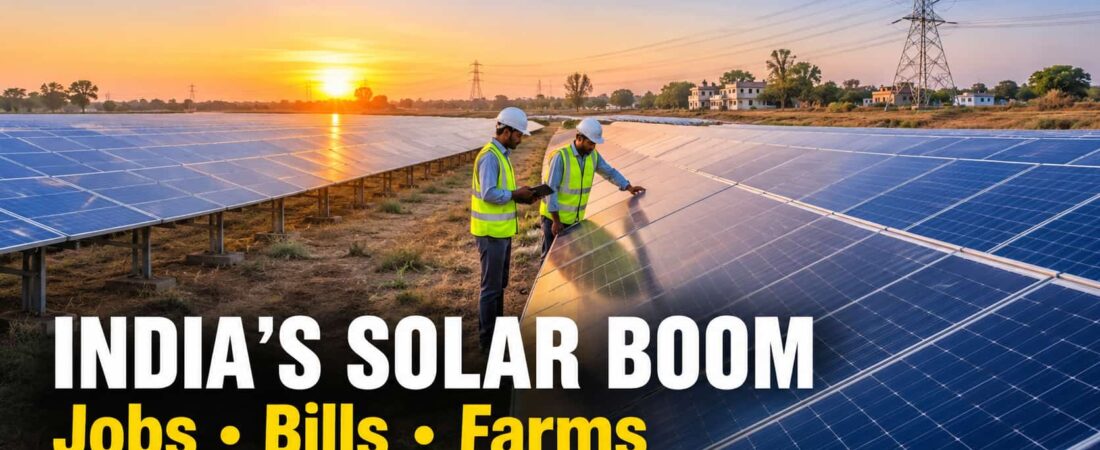
For years, India’s solar story was told in gigawatts: capacity added, milestones crossed, records broken. On 2 November 2026, Prime Minister Narendra Modi pointed to the part of the story that reaches ordinary households, farms and job seekers.
The message was short, but it carried weight. Prime Minister Narendra Modi said India’s clean energy transition is gathering pace, with solar playing a growing role in meeting the country’s energy needs. He made the point while sharing two articles by Union Minister Pralhad Joshi, as Akashvani News reported.
That is why India Solar Energy Growth is worth understanding beyond the headline number. Panels on a roof can change a monthly bill. Pumps on a farm can replace diesel. Factories, grids and installers need people. This article walks through what was said, what the official data shows, and what it could mean for students and young professionals.
 Written by Shivam Kumar | Published: 2 November 2026 | Source: Akashvani News (Official)
At a glance
- PM Modi said India’s clean energy transition is gathering pace, with solar playing a growing role.
- He shared two articles by Pralhad Joshi, one co-written with Michael R. Bloomberg, founder of Bloomberg L.P.
- Solar is 164.59 GW of India’s 300.50 GW non-fossil capacity, as of 31 July 2026, according to MNRE.
- PM Surya Ghar is for households. PM-KUSUM is for farmers.
- The Akashvani report does not announce any new scheme, subsidy, deadline or recruitment drive.
In short: PM Modi said solar is opening up new opportunities, citing articles that highlight rooftop solar, storage, transmission, lower bills, jobs and energy security. It was a statement of direction, not a new policy.
What did PM Modi actually say?
The first article was written by Pralhad Joshi, Union Minister of New and Renewable Energy, together with Michael R. Bloomberg. The Prime Minister noted that it stresses the growth of renewable energy, the spread of rooftop solar and investment in storage and transmission. It also highlights how the shift is helping reduce electricity bills, create jobs and strengthen energy security.
The second article was written by Mr Joshi alone. It credits initiatives such as PM Surya Ghar and PM-KUSUM for the growth of solar power. It also looks ahead to solar-powered agriculture, energy storage, manufacturing and green jobs as India works towards its 500 GW target.
One point of caution. The claims about bills, jobs and energy security belong to the articles’ authors, relayed by the Prime Minister. We have not seen the full articles, only Akashvani’s summary, so this report treats those claims as the authors’ view and not as independently verified findings.
According to the original report published by Akashvani News [Click Here to Read the Official Report]
The number behind the message
The Ministry of New and Renewable Energy (MNRE) reported that India’s non-fossil electricity capacity reached 300.50 GW on 31 July 2026. Solar is the biggest part of that, at 164.59 GW, followed by wind at 58.14 GW, hydropower at 57.24 GW, bio-power at 11.75 GW and nuclear at 8.78 GW.
Solar is also the fastest mover. MNRE data reported by the trade press show a record 44.6 GW of solar added in 2025-26. Put simply, India Solar Energy Growth is now the main engine of the country’s clean power expansion.
Why does this matter to a reader who never looks at power-sector data? Because solar sits in the one place most clean energy cannot: on your own roof or farm. That makes it the most visible part of the energy transition, and the part most connected to livelihoods.
There is a catch, which the articles hint at by naming storage and transmission. Solar generates only in daylight. Batteries store surplus power for the evening, and transmission lines carry electricity from sunny regions to cities. Without both, panels alone cannot supply power round the clock.
For homes: what PM Surya Ghar offers
The PM Surya Ghar scheme, formally PM Surya Ghar: Muft Bijli Yojana, was launched on 13 February 2024 with an outlay of ₹75,021 crore. It aims to install rooftop solar in one crore households and provide up to 300 units of free electricity every month. Households register on the official PM Surya Ghar portal and choose a vendor.
The subsidy depends on system size. At benchmark prices, it is ₹30,000 for a 1 kW system, ₹60,000 for 2 kW and ₹78,000 for 3 kW or more. According to PIB’s scheme note, households using 150 to 300 units a month are matched with 2 to 3 kW systems and ₹60,000 to ₹78,000 of support. The same note sets a target of one crore installations by 2027.
In plain terms: a family with a steady monthly bill and a usable roof is the target beneficiary. Whether it saves money depends on the roof, the system and local tariffs, so check the portal for current rules before applying.
For farms: what PM-KUSUM offers
PM-KUSUM (Pradhan Mantri Kisan Urja Suraksha evam Utthaan Mahabhiyan) is run by MNRE for farmers, not households. It has three parts, described in MNRE’s own summary:
- Component A: small solar plants of up to 2 MW on farmers’ barren or fallow land, with a target of 10,000 MW.
- Component B: 20 lakh stand-alone solar pumps, mainly to replace diesel pumps.
- Component C: solarisation of 15 lakh existing grid-connected agricultural pumps.
The practical idea is that a farmer pays less for fuel or power and, in some cases, earns by selling electricity. Together with PM Surya Ghar, it is a main route through which India Solar Energy Growth reaches ordinary people. Subsidy and eligibility differ by component and state, so read the PM-KUSUM guidelines before applying.
Village-level governance shapes how rural schemes reach people. For how Panchayats are being strengthened, see our explainer on PM Viksit Gram Swaraj Yojana 2026, and browse our government schemes coverage for similar topics.
India’s 500 GW target: renewable or non-fossil?
Akashvani describes the goal as a 500 GW renewable energy target. MNRE’s official wording is slightly broader: 500 GW of non-fossil electricity capacity by 2030, a commitment announced at COP26 in 2021. Non-fossil includes nuclear and hydropower alongside solar, wind and bio-power. So the target is not solar-only, and solar is one major part of it.
With 300.50 GW installed, India is over 60% of the way there, which leaves roughly 200 GW to add by 2030. Solar will probably carry a large share, since it is the biggest block today. That is our analysis, not an official projection.
The cost is large. Mr Joshi has said India needs more than ₹30 lakh crore of investment over five years to reach the goal, as reported by Energetica India. Treat that as the minister’s estimate, not a guarantee.
Where the opportunities could be
The articles name five areas. Each is a possible source of work, but none is a promised job count.
- Manufacturing: Government incentives for high-efficiency solar modules aim to build domestic capacity, which needs engineers, technicians and quality testers.
- Rooftop installation: Every subsidised system needs surveyors, installers, electricians and maintenance staff.
- Solar agriculture: Pumps and farm-side plants link energy with irrigation and rural income.
- Energy storage: Batteries are what make daytime solar usable at night, and they need design, operation and safety skills.
- Transmission: New lines to move power are construction and grid-engineering work.
No official job numbers were given in the Akashvani report, and this article does not invent any.
What India Solar Energy Growth means for young Indians
The next phase of India Solar Energy Growth will depend as much on skilled people as on panels. For anyone exploring solar energy careers in India, the paths vary by qualification:
- ITI and diploma holders: installation, wiring, inverter and battery maintenance.
- Engineering graduates: system design, project management, testing, grid integration.
- Finance and data graduates: energy analysis, project funding, performance monitoring.
MNRE runs short-term training under its human resource development scheme, including the Suryamitra programme for solar technicians. Our skill development guides and career guidance section can help you plan a learning path, and our science and technology updates track related developments.
A reality check: training is not placement. In 2022 the then minister said 26,967 of 51,331 trained Suryamitras had found employment. That is useful experience data, not a guarantee. Be careful with private institutes that promise jobs, and verify any course on official portals.
What could go wrong, and what to watch
The opportunity is real, but so are the hurdles. Storage and transmission must keep pace with solar additions, or generation will outrun the grid’s ability to use it. PM-KUSUM’s Component A has also moved slowly: Parliament data reported in March 2026 showed about 721 MW installed against a 10,000 MW target. Pumps under Components B and C have moved faster.
The next step to watch is formal announcements from MNRE and PIB, not commentary. Nothing in the Akashvani report sets a timeline or a new policy.
The bottom line
Solar’s real test is whether it reaches beyond the megawatt headline. If rooftops lower bills, pumps cut farm costs, and factories and grids hire locally, India Solar Energy Growth becomes an economic story and not only an energy one. The Prime Minister has pointed to the direction. Execution, in the form of storage, transmission, investment and skills, will decide who benefits.
FAQs
1. What did PM Modi say about India’s solar energy journey?
He said India’s clean energy transition is gathering pace and solar is opening new opportunities, while sharing two articles by Pralhad Joshi, one co-written with Michael R. Bloomberg.
2. What is India’s 500 GW renewable energy target?
MNRE describes it as 500 GW of non-fossil electricity capacity by 2030, covering solar, wind, hydro, bio-power and nuclear. Akashvani calls it a renewable energy target.
3. What is the PM Surya Ghar scheme?
A rooftop solar scheme with a ₹75,021 crore outlay, aiming at one crore households with subsidy of up to ₹78,000 and up to 300 free units a month. Apply on pmsuryaghar.gov.in.
4. How does PM-KUSUM help farmers?
It supports stand-alone solar pumps, solarisation of grid-connected pumps and small solar plants on farmland, cutting diesel and power costs and, in some cases, creating income.
5. What career opportunities are emerging in India’s solar energy sector?
Installation, maintenance, manufacturing, storage, grid engineering and project management. Jobs are not guaranteed, so check official skilling programmes.